Representing geometric morphisms using power locale monads
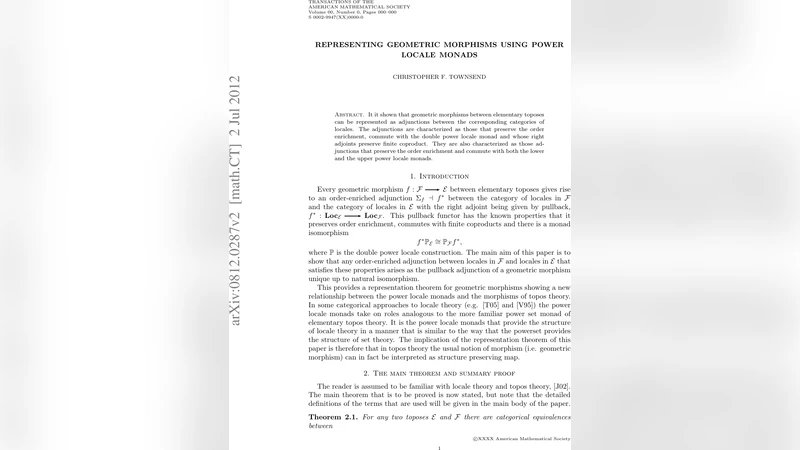
It it shown that geometric morphisms between elementary toposes can be represented as adjunctions between the corresponding categories of locales. These adjunctions are characterised as those that preserve the order enrichment, commute with the double power locale monad and whose right adjoints preserve finite coproduct. They are also characterised as those adjunctions that preserve the order enrichment and commute with both the upper and the lower power locale monads.
💡 Research Summary
The paper establishes a precise categorical correspondence between geometric morphisms of elementary toposes and adjunctions between their associated locale categories, using the machinery of power‑locale monads. After recalling that each elementary topos 𝔈 carries an internal locale category Loc(𝔈) equipped with an order‑enriched complete lattice structure, the authors introduce three monads on Loc(𝔈): the upper power‑locale monad P⁺ (which collects open sublocales), the lower power‑locale monad P⁻ (which collects closed sublocales), and the double power‑locale monad P² obtained by composing P⁺ and P⁻. These monads encode the familiar “power‑set” constructions internal to a topos, but refined to respect the locale structure.
The central theorem states that a geometric morphism f : 𝔈 → 𝔽 is uniquely represented by an adjunction (f⁎ ⊣ f₊) between Loc(𝔽) and Loc(𝔈). Here f⁎ is the inverse‑image functor on locales (pull‑back of opens) and f₊ is the direct‑image (or “upper‑image”) functor. The authors identify three equivalent characterisations of those adjunctions that arise from geometric morphisms:
-
Order‑enrichment preservation – both f⁎ and f₊ are monotone with respect to the inclusion order on locales; they respect the lattice structure.
-
Commutation with the double power‑locale monad – there are natural isomorphisms f⁎ ∘ P² ≅ P² ∘ f⁎ and f₊ ∘ P² ≅ P² ∘ f₊. In other words, the adjunction is a strong morphism of the monad P²; the power‑locale constructions are invariant under the functors.
-
Finite‑coproduct preservation by the right adjoint – f₊ preserves binary joins and the initial object (the empty locale). This condition mirrors the classical requirement that geometric morphisms preserve finite limits and colimits of the internal logic.
A striking secondary result shows that the three conditions above are equivalent to a single, more symmetric requirement: the adjunction must commute separately with both the upper and the lower power‑locale monads (P⁺ and P⁻). If f⁎ and f₊ are strong monad morphisms for each of P⁺ and P⁻, then automatically they are strong for the composite P² and the right adjoint preserves finite coproducts. This equivalence leverages the algebraic properties of monads (unit and multiplication) and the fact that P² is essentially the tensor product of P⁺ and P⁻ in the 2‑category of monads.
To substantiate the abstract theory, the paper works through concrete examples. The familiar geometric morphism between the topos of sets Set and the topos of sheaves on the real line Sh(ℝ) is examined; the corresponding locale adjunction is described explicitly, and the required natural isomorphisms with P⁺, P⁻, and P² are constructed. These examples illustrate how the abstract commutation conditions translate into concrete preservation of open and closed subspaces under inverse‑image and direct‑image functors.
The authors also discuss the broader implications of their work. By framing geometric morphisms as monad‑compatible adjunctions, they provide a unifying perspective that bridges topos theory, locale theory, and monad theory. This viewpoint generalises the classical spectrum‑frame duality: instead of focusing solely on frames (locales) of points, the power‑locale monads capture higher‑order “subspace” constructions, and the adjunctions respecting them encode precisely the logical (geometric) structure preserved by morphisms of toposes.
In conclusion, the paper delivers a robust categorical characterisation of geometric morphisms via power‑locale monads. It shows that the essential features of a geometric morphism—order preservation, logical coherence, and compatibility with power‑locale constructions—are exactly those needed for an adjunction to be a strong monad morphism for P² (or equivalently for both P⁺ and P⁻) and to preserve finite coproducts on the right. This result not only deepens our understanding of the interplay between topos‑theoretic and locale‑theoretic perspectives but also opens avenues for applying monadic techniques to other areas of categorical topology and logic.
Comments & Academic Discussion
Loading comments...
Leave a Comment