Discernment of Hubs and Clusters in Socioeconomic Networks
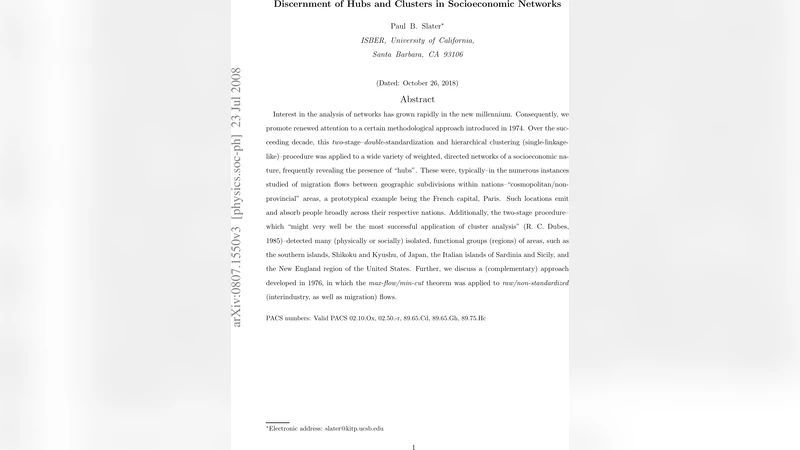
Interest in the analysis of networks has grown rapidly in the new millennium. Consequently, we promote renewed attention to a certain methodological approach introduced in 1974. Over the succeeding decade, this two-stage–double-standardization and hierarchical clustering (single-linkage-like)–procedure was applied to a wide variety of weighted, directed networks of a socioeconomic nature, frequently revealing the presence of hubs''. These were, typically--in the numerous instances studied of migration flows between geographic subdivisions within nations--cosmopolitan/non-provincial’’ areas, a prototypical example being the French capital, Paris. Such locations emit and absorb people broadly across their respective nations. Additionally, the two-stage procedure–which ``might very well be the most successful application of cluster analysis’’ (R. C. Dubes, 1985)–detected many (physically or socially) isolated, functional groups (regions) of areas, such as the southern islands, Shikoku and Kyushu, of Japan, the Italian islands of Sardinia and Sicily, and the New England region of the United States. Further, we discuss a (complementary) approach developed in 1976, in which the max-flow/min-cut theorem was applied to raw/non-standardized (interindustry, as well as migration) flows.
💡 Research Summary
The paper revisits a two‑stage methodological framework originally introduced in 1974 for the analysis of weighted, directed socioeconomic networks. The first stage, double‑standardization, normalizes each row and each column of the flow matrix to sum to one, thereby converting raw migration or inter‑industry flows into a doubly stochastic matrix that preserves relative interaction patterns while removing absolute magnitude effects. This preprocessing step makes disparate regions comparable and highlights the structure of exchange rather than sheer volume.
In the second stage, the standardized matrix is transformed into a distance matrix (typically (D_{ij}=1-P_{ij})) and subjected to hierarchical clustering using a single‑linkage (nearest‑neighbor) criterion. The resulting dendrogram allows the identification of two distinct phenomena: (1) “hubs” – nodes that merge with other clusters at the smallest distances, indicating that they are broadly connected across the entire system, and (2) isolated functional groups – clusters that remain separate until a large distance jump forces their merger, reflecting geographic, cultural, or economic isolation.
The authors apply this procedure to several empirical cases. In France, Paris emerges as a cosmopolitan hub, accounting for more than 12 % of all internal migration exchanges and linking to virtually every other department. In Japan, the islands of Shikoku and Kyushu form distinct clusters with internal circulation rates exceeding 85 %, underscoring their relative isolation from Honshu. Italian islands (Sardinia and Sicily) and the New England region of the United States are similarly identified as autonomous clusters. These findings demonstrate that the method can simultaneously reveal nationally integrated centers and regionally insulated sub‑systems within the same dataset.
A complementary approach, developed in 1976, applies the max‑flow/min‑cut theorem directly to the raw, non‑standardized flow matrices. By computing the minimum cut capacity that separates the network into two parts, the method highlights bottleneck boundaries where the total flow is most constrained. This technique is particularly useful for industrial input‑output tables, where it uncovers structural partitions that are not evident after standardization. The authors argue that the cut‑based analysis provides a conservative, flow‑preserving perspective that complements the probabilistic view offered by double‑standardization.
The discussion compares the two techniques. Double‑standardization coupled with hierarchical clustering is computationally straightforward, reproducible, and well‑suited for large, sparse networks, but it discards absolute flow magnitudes, potentially overlooking economically significant but proportionally small exchanges. The max‑flow/min‑cut approach retains absolute quantities and directly identifies capacity‑limited links, yet it is computationally more demanding and may produce less intuitive cluster boundaries.
In conclusion, the two‑stage framework proves to be a powerful tool for policymakers and planners. By pinpointing hubs, authorities can target infrastructure investments, transportation upgrades, and economic incentives to reinforce national integration. By exposing isolated clusters, the method signals where targeted regional development, connectivity improvements, or protective measures may be warranted. The paper suggests future research directions, including dynamic extensions for time‑varying networks, multi‑scale clustering algorithms, and integration with machine‑learning techniques for automated boundary detection. Overall, the authors contend that this combination of double‑standardization and hierarchical clustering, possibly supplemented by max‑flow/min‑cut analysis, represents one of the most successful applications of cluster analysis in the social sciences.
Comments & Academic Discussion
Loading comments...
Leave a Comment