Asymmetric separation for local independence graphs
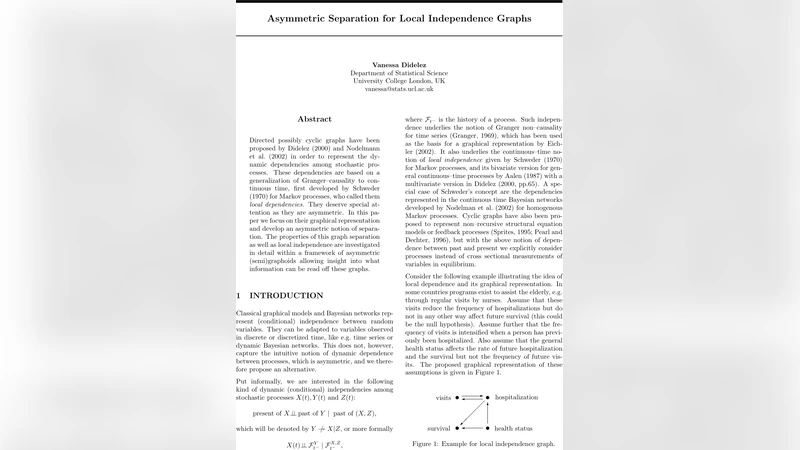
Directed possibly cyclic graphs have been proposed by Didelez (2000) and Nodelmann et al. (2002) in order to represent the dynamic dependencies among stochastic processes. These dependencies are based on a generalization of Granger-causality to continuous time, first developed by Schweder (1970) for Markov processes, who called them local dependencies. They deserve special attention as they are asymmetric unlike stochastic (in)dependence. In this paper we focus on their graphical representation and develop a suitable, i.e. asymmetric notion of separation, called delta-separation. The properties of this graph separation as well as of local independence are investigated in detail within a framework of asymmetric (semi)graphoids allowing a deeper insight into what information can be read off these graphs.
💡 Research Summary
The paper addresses the problem of representing dynamic dependencies among stochastic processes in continuous time using graphical models. Traditional directed acyclic graphs (DAGs) and the associated d‑separation criterion are inadequate for this setting because the underlying dependencies—known as local independence—are inherently asymmetric, reflecting a continuous‑time version of Granger causality. Earlier work by Didelez (2000) and Nodelmann et al. (2002) introduced directed possibly cyclic graphs (DPCGs) that allow cycles and thus can encode feedback loops, but they did not provide a suitable notion of separation that respects the asymmetry of local independence.
The authors propose δ‑separation (delta‑separation) as a new, asymmetric graph‑theoretic separation concept tailored to DPCGs. A path between two node sets A and B is considered active with respect to a conditioning set C only if the directionality of each edge and the presence of collider (colliding) nodes satisfy specific non‑symmetrical criteria. In particular, a collider blocks a path unless it (or one of its descendants) is included in C, mirroring the familiar rule from d‑separation, but the treatment of non‑colliders is direction‑dependent: a non‑collider blocks a path when the arrow points into the node from the side of A, but not when it points away. This asymmetry directly captures the one‑way influence encoded by local independence.
The paper establishes several fundamental results. First, Theorem 1 proves the equivalence between δ‑separation and local independence: A is locally independent of B given C if and only if A and B are δ‑separated by C in the DPCG. Second, Theorem 2 shows that δ‑separation satisfies an asymmetric semi‑graphoid set of axioms (asymmetry, decomposition, weak union, and contraction), providing a logical calculus for reasoning about conditional independencies in this non‑symmetric setting. Third, Theorem 3 demonstrates that δ‑separation remains well‑defined even in the presence of directed cycles, and the authors present an algorithm—an adaptation of depth‑first search used for d‑separation—that efficiently checks δ‑separation by tracking edge orientation and collider status during traversal.
The authors compare δ‑separation with the classical d‑separation. While d‑separation is symmetric and thus unsuitable for Granger‑type causal statements, δ‑separation preserves directionality and therefore aligns with the continuous‑time causality notion. Moreover, δ‑separation can be integrated with statistical estimation procedures such as partial likelihood or penalised likelihood methods, enabling model selection criteria (AIC, BIC) that respect the underlying asymmetric independencies.
A practical illustration involves point‑process data from physiological recordings (e.g., heart‑rate and respiration). By constructing a DPCG for the two processes and applying δ‑separation, the authors identify which process exerts a leading influence on the other, a conclusion that would be ambiguous under d‑separation. The example underscores the added interpretability afforded by the asymmetric separation rule.
In the discussion, the authors acknowledge that the worst‑case computational complexity of δ‑separation is exponential, but note that many real‑world networks are sparse, allowing for tractable implementations. They also outline future research directions, including extensions to non‑Markovian or non‑linear processes, development of scalable approximation algorithms, and exploration of connections with Bayesian networks that incorporate asymmetric independencies.
Overall, the paper makes a significant contribution by formalising a graph‑based separation criterion that faithfully reflects the asymmetric nature of local independence in continuous‑time stochastic systems. δ‑separation bridges the gap between causal time‑series analysis and graphical modelling, providing both theoretical insight and practical tools for researchers working with dynamic, feedback‑rich processes.