A Permutation Approach to Testing Interactions in Many Dimensions
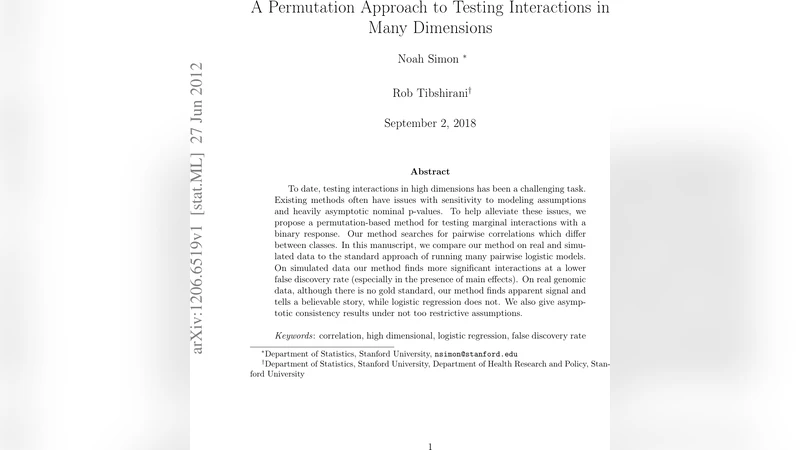
To date, testing interactions in high dimensions has been a challenging task. Existing methods often have issues with sensitivity to modeling assumptions and heavily asymptotic nominal p-values. To help alleviate these issues, we propose a permutation-based method for testing marginal interactions with a binary response. Our method searches for pairwise correlations which differ between classes. In this manuscript, we compare our method on real and simulated data to the standard approach of running many pairwise logistic models. On simulated data our method finds more significant interactions at a lower false discovery rate (especially in the presence of main effects). On real genomic data, although there is no gold standard, our method finds apparent signal and tells a believable story, while logistic regression does not. We also give asymptotic consistency results under not too restrictive assumptions.
💡 Research Summary
The paper addresses the longstanding difficulty of detecting interactions among a large number of predictors when the response is binary. Traditional approaches typically fit a separate logistic regression for each pair of variables and then apply multiple‑testing corrections. While straightforward, this strategy suffers from three major drawbacks: (1) it relies heavily on the correctness of the logistic model (linearity on the log‑odds scale, correct specification of main effects), (2) it becomes computationally burdensome as the number of predictors grows, and (3) it loses power, especially when strong main effects are present because the logistic model can absorb interaction signals into the main‑effect terms.
To overcome these issues, the authors propose a permutation‑based test that focuses on marginal interactions. For any pair of predictors (X_i, X_j) they compute the Pearson correlation within each class (Y=0 and Y=1) and consider the absolute difference Δ_ij = |ρ_ij^0 – ρ_ij^1| as the test statistic. Under the null hypothesis that the correlation structure is identical across classes, the class labels are exchangeable. By repeatedly permuting the labels (typically 1,000–10,000 times) and recomputing Δ_ij for each permutation, an empirical null distribution is obtained. The p‑value for the observed Δ_ij is the proportion of permuted Δ_ij that are at least as large. Because the permutation respects the joint distribution of the predictors, the test does not depend on any parametric model for the response.
The authors also discuss practical implementation details. The correlation matrix for the whole dataset is computed once; during each permutation only the class‑specific sub‑matrices need to be recomputed, which reduces the computational complexity to O(N·P^2) where N is the sample size and P the number of predictors. After obtaining raw p‑values for all (P choose 2) pairs, the Benjamini–Hochberg procedure is applied to control the false discovery rate (FDR).
Theoretical contributions include a proof of asymptotic consistency under mild conditions: if a true difference in correlations exists, the permutation statistic converges in probability to 1, whereas under the null it converges to the empirical null distribution. This result requires only that the predictors have finite second moments and that the two classes are independent draws from their respective distributions, which is considerably weaker than the assumptions needed for logistic regression.
Empirical evaluation proceeds in two parts. In simulation studies the authors generate data with varying signal‑to‑noise ratios, different strengths of main effects, and diverse correlation structures (e.g., block‑diagonal, AR(1)). They compare the proposed method to the standard pairwise logistic approach in terms of true positive rate at a fixed FDR of 0.05. The permutation test consistently discovers more true interactions, especially when main effects are strong; the logistic method’s false discovery rate inflates and its power drops dramatically.
A real‑world case study uses a high‑dimensional genomic dataset (gene expression measurements from cancer patients versus normal tissue). No external gold standard exists, but the authors examine biological plausibility. The permutation test identifies several gene pairs whose correlation differs markedly between tumor and normal samples, many of which belong to known oncogenic pathways (e.g., MAPK, PI3K‑AKT). In contrast, the logistic regression approach yields few significant pairs, and those that appear are not enriched for any recognizable pathway.
The discussion acknowledges limitations: the method tests only linear correlation differences, so non‑linear interactions may be missed; the computational cost of permutations can be high for extremely large P, though parallelization and approximate permutation schemes (e.g., using a subset of permutations) can mitigate this. Potential extensions include adapting the test to multinomial outcomes, employing rank‑based or robust correlation measures for non‑Gaussian data, and integrating the approach with hierarchical testing frameworks.
In conclusion, the paper presents a robust, model‑free permutation test for marginal interactions in high‑dimensional binary classification problems. By sidestepping the strong parametric assumptions of logistic regression and by providing rigorous FDR control, the method offers higher power and lower false discovery rates in both simulated and real genomic contexts. Its theoretical guarantees and practical performance suggest it could become a valuable tool for biomarker discovery, risk‑factor interaction studies, and any setting where interaction detection in many dimensions is required.
Comments & Academic Discussion
Loading comments...
Leave a Comment