On the retrieval of attenuation from the azimuthally averaged coherency of a diffuse field
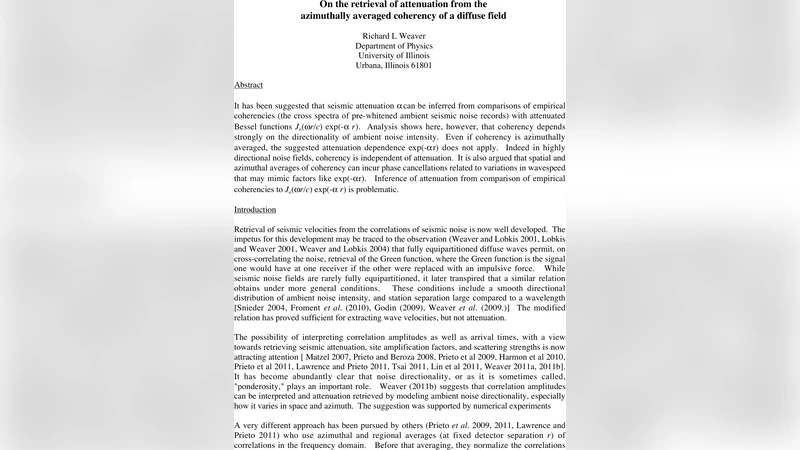
It has been suggested that seismic attenuation \alpha can be inferred from comparisons of empirical coherencies (the cross spectra of pre-whitened ambient seismic noise records) with attenuated Bessel functions Jo(\omega r/c) exp(-\alpha r). Analysis shows here, however, that coherency depends strongly on the directionality of ambient noise intensity. Even if coherency is azimuthally averaged, the suggested attenuation dependence exp(-\alpha r) does not apply. Indeed in highly directional noise fields, coherency is independent of attenuation. It is also argued that spatial and azimuthal averages of coherency can incur phase cancellations related to variations in wavespeed that may mimic factors like exp(-\alpha r). Inference of attenuation from comparison of empirical coherencies to Jo(\omega r/c) exp(-\alpha r) is problematic.
💡 Research Summary
The paper critically examines the widely‑used practice of estimating seismic attenuation (α) from the azimuthally averaged coherency of ambient seismic noise. Coherency is defined as the cross‑spectrum of pre‑whitened noise records, normalized by the individual power spectra, and under the idealised assumption of an isotropic diffuse field it is expected to follow the analytic form J₀(ωr/c) exp(−αr), where J₀ is the zeroth‑order Bessel function, ω the angular frequency, r the inter‑station distance, and c the average wave speed. By comparing measured coherencies with this expression, many studies have inferred α.
The author demonstrates that this approach neglects two fundamental aspects of real ambient noise: (1) the strong directionality of the noise source field, and (2) spatial variations in wave speed. First, a simple model of a single plane wave arriving from direction θ is considered. The exact coherency for this case is C( r,ω,θ)=exp
Comments & Academic Discussion
Loading comments...
Leave a Comment