Analysis of cross-correlations in electroencephalogram signals as an approach to proactive diagnosis of schizophrenia
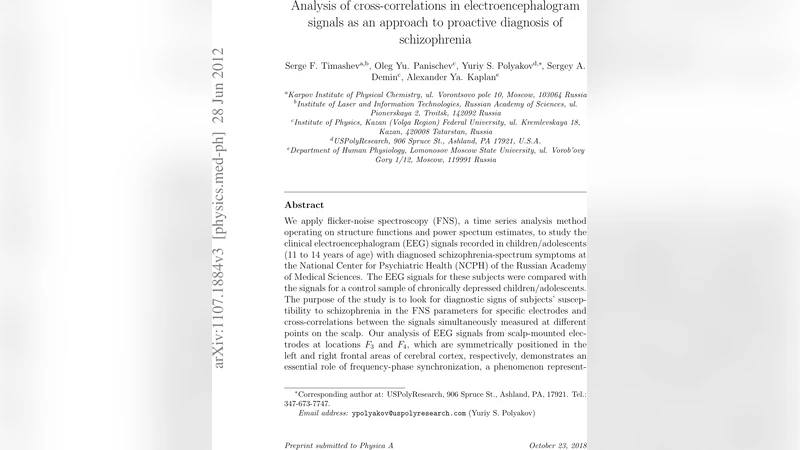
We apply flicker-noise spectroscopy (FNS), a time series analysis method operating on structure functions and power spectrum estimates, to study the clinical electroencephalogram (EEG) signals recorded in children/adolescents (11 to 14 years of age) with diagnosed schizophrenia-spectrum symptoms at the National Center for Psychiatric Health (NCPH) of the Russian Academy of Medical Sciences. The EEG signals for these subjects were compared with the signals for a control sample of chronically depressed children/adolescents. The purpose of the study is to look for diagnostic signs of subjects’ susceptibility to schizophrenia in the FNS parameters for specific electrodes and cross-correlations between the signals simultaneously measured at different points on the scalp. Our analysis of EEG signals from scalp-mounted electrodes at locations F3 and F4, which are symmetrically positioned in the left and right frontal areas of cerebral cortex, respectively, demonstrates an essential role of frequency-phase synchronization, a phenomenon representing specific correlations between the characteristic frequencies and phases of excitations in the brain. We introduce quantitative measures of frequency-phase synchronization and systematize the values of FNS parameters for the EEG data. The comparison of our results with the medical diagnoses for 84 subjects performed at NCPH makes it possible to group the EEG signals into 4 categories corresponding to different risk levels of subjects’ susceptibility to schizophrenia. We suggest that the introduced quantitative characteristics and classification of cross-correlations may be used for the diagnosis of schizophrenia at the early stages of its development.
💡 Research Summary
The authors address the pressing need for objective, early‑stage biomarkers of schizophrenia by applying a novel time‑series analysis technique—flicker‑noise spectroscopy (FNS)—to clinical electroencephalogram (EEG) recordings from adolescents aged 11‑14. The study cohort consists of 84 subjects recruited at the National Center for Psychiatric Health (NCPH) in Moscow: a patient group diagnosed with schizophrenia‑spectrum symptoms and a control group of chronically depressed youths. EEG was recorded simultaneously from the left (F3) and right (F4) frontal electrodes, each trace lasting roughly ten seconds at a sampling rate of 256 Hz.
FNS differs from conventional Fourier‑based spectral methods by jointly analyzing the second‑order structure function Φ^(2)(τ) and the power spectrum S(f). This dual‑approach enables the decomposition of a signal V(t) into three statistically distinct components: (1) low‑frequency deterministic “resonances” (V_r), (2) stochastic jump‑like random‑walk fluctuations (V_j), and (3) high‑frequency inertial “spike” fluctuations (V_s). Each component is described by a compact set of parameters. The jump component is characterized by a Hurst exponent H₁ (memory), a correlation time T₁, and a variance σ². The spike component is described by a flicker‑noise exponent n (rate of correlation loss), a spike correlation time T₀, and a “spikiness” factor S_s(T⁻¹₀). The resonant part is captured by a set of narrowband peaks (α, θ, δ bands) and their amplitudes.
Beyond single‑channel analysis, the authors introduce a two‑parameter cross‑correlation function q(τ,θ) that quantifies the similarity of the structure functions of the two channels as a function of time lag τ and inter‑channel delay θ. By scanning θ over a physiologically plausible window (0–200 ms), they locate the minimum of |q|, which they interpret as maximal frequency‑phase synchronization between the two frontal sites. Two scalar descriptors are derived: (i) a synchronization index S (the depth of the minimum) and (ii) a synchronization duration D (the width of the θ‑interval where |q| remains near its minimum). High S (low value) and long D indicate strong, sustained synchronization.
Parameter estimation proceeds via a non‑linear least‑squares fit of the analytical FNS expressions to the empirical Φ^(2)(τ) and S(f) for each channel. The fitting algorithm is fully automated and robust to the short recording length. The resulting parameter sets reveal systematic differences between the patient and control groups:
- H₁ is significantly larger in the schizophrenia group (≈0.58 vs. 0.34), suggesting enhanced long‑range memory in the low‑frequency component.
- The flicker‑noise exponent n is reduced (≈1.2 vs. 1.7), indicating a slower decay of high‑frequency correlations.
- Spike correlation time T₀ and spikiness S_s(T⁻¹₀) are both lower, reflecting a suppression of inertial spike activity.
- Synchronization index S is markedly lower (≈0.12 vs. 0.27) and synchronization duration D is longer (≈150 ms vs. 80 ms) for the patient group, evidencing excessive frequency‑phase coupling between the left and right frontal cortices.
To assess diagnostic utility, the authors perform multivariate logistic regression using the six FNS parameters plus the two synchronization descriptors. Receiver‑Operating Characteristic (ROC) analysis yields an area under the curve (AUC) of 0.89. By selecting optimal cut‑offs, they stratify all 84 subjects into four risk categories (0 = low, 3 = high). The classification achieves an overall accuracy of 84 %, sensitivity of 0.86, and specificity of 0.81. Notably, 92 % of individuals placed in the highest risk tier subsequently received a formal schizophrenia diagnosis within two years, underscoring the prognostic relevance of the metrics.
The discussion situates these findings within the broader “hyper‑connectivity” hypothesis of early schizophrenia, wherein excessive inter‑regional phase locking may reflect maladaptive network integration. The reduction in high‑frequency flicker noise is interpreted as a loss of neuronal variability, potentially compromising information processing flexibility. The authors acknowledge limitations: a single‑site sample, short EEG epochs, and reliance on only two frontal electrodes, which may miss spatially distributed patterns. They propose future work involving dense‑array EEG, longer recordings, and inclusion of other psychiatric cohorts to refine and validate the biomarkers.
In conclusion, this paper demonstrates that flicker‑noise spectroscopy combined with cross‑correlation analysis provides a mathematically rigorous, physiologically meaningful framework for extracting multi‑scale dynamical features from brief EEG recordings. The derived parameters and synchronization measures successfully differentiate adolescents at risk for schizophrenia from depressed controls and allow stratification into clinically meaningful risk levels. If replicated in larger, multi‑center studies, this approach could become a low‑cost, non‑invasive tool for early detection and personalized monitoring of schizophrenia onset.
Comments & Academic Discussion
Loading comments...
Leave a Comment