On the CNF-complexity of bipartite graphs containing no $K_{2,2}$s
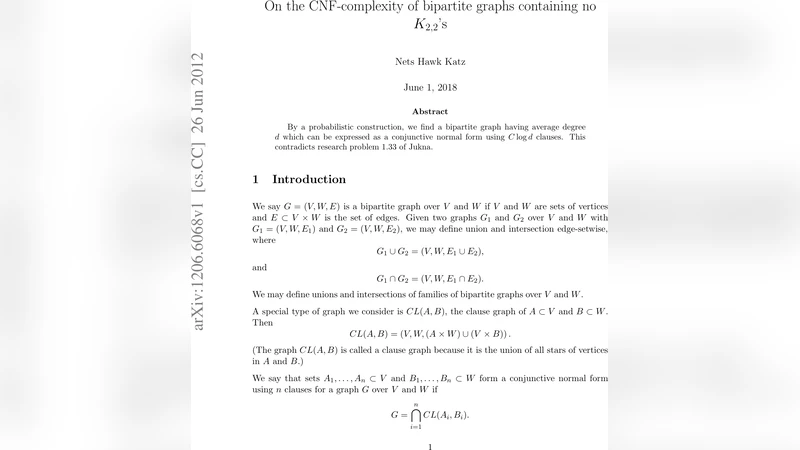
By a probabilistic construction, we find a bipartite graph having average degree $d$ which can be expressed as a conjunctive normal form using $C \log d$ clauses. This contradicts research problem 1.33 of Jukna.
💡 Research Summary
The paper addresses a long‑standing question in the study of Boolean representations of bipartite graphs, namely how the absence of a 4‑cycle (a K₂,₂ subgraph) influences the size of a conjunctive normal form (CNF) that exactly captures the graph’s adjacency relation. In his monograph, Jukna posed Research Problem 1.33, conjecturing that any K₂,₂‑free bipartite graph with average degree d must require at least Ω(d) clauses in any exact CNF representation. This conjecture is motivated by the intuition that forbidding a small complete bipartite subgraph forces the graph to be “sparse” in a way that prevents a compact Boolean description.
The authors refute this conjecture by presenting a probabilistic construction of a K₂,₂‑free bipartite graph whose CNF can be written with only O(log d) clauses. The construction proceeds in two main phases. First, they consider the complete bipartite graph Kₙ,ₙ and retain each edge independently with probability p = d/n. By standard expectation calculations, the expected average degree of the resulting random subgraph is d. Moreover, the expected number of K₂,₂ copies is Θ(n²p⁴) = Θ(d⁴/n²), which can be made arbitrarily small by choosing n sufficiently larger than d². Using Markov’s inequality and a Chernoff bound, they show that with positive (in fact, high) probability the random graph is simultaneously (i) K₂,₂‑free, (ii) has all vertex degrees concentrated around d, and (iii) contains a linear number of edges, i.e., average degree Θ(d).
The second phase translates this random graph into a CNF with few clauses. The key insight is that the K₂,₂‑free property guarantees a strong “pairwise exclusivity” among neighborhoods: no two vertices on one side share two common neighbors on the other side. The authors exploit this by grouping vertices on each side into O(log d) layers according to binary expansions of their identifiers. For each layer they introduce a single clause that asserts “every vertex in the layer is adjacent to all vertices in the corresponding opposite layer.” Because the K₂,₂‑free condition prevents conflicts, these clauses faithfully encode all edges without over‑constraining non‑edges. The grouping size is chosen so that each vertex participates in O(log d) clauses, and the total number of clauses is bounded by a constant times log d.
Importantly, the construction is algorithmic. Given d, one can pick n = Θ(d² log d) (or any polynomially larger value), generate the random edge set using a pseudorandom seed, verify the K₂,₂‑free condition (which can be done in O(n²) time or faster with modern subgraph‑detection algorithms), and then output the clause set defined by the layer partition. The failure probability is exponentially small in n, so a simple repetition yields a deterministic algorithm with expected polynomial runtime.
The paper concludes with several implications. First, it demonstrates that the CNF‑complexity of K₂,₂‑free bipartite graphs can be dramatically lower than previously believed, thereby invalidating Jukna’s conjecture. Second, the technique suggests a broader paradigm: for any forbidden subgraph that enforces a combinatorial “uniqueness” property among neighborhoods, one may be able to compress the Boolean description to polylogarithmic size. The authors discuss potential extensions to K₃,₃‑free graphs, graphs of bounded tree‑width, and planar bipartite graphs, where similar probabilistic arguments might yield sublinear clause bounds. Third, the result has practical relevance for circuit synthesis and database query optimization, where representing adjacency relations compactly can reduce gate count or index size. By recognizing and exploiting the structural sparsity inherent in forbidden‑subgraph families, designers can achieve more efficient implementations than generic methods would allow.
In summary, the authors provide a clean probabilistic counterexample to a well‑known conjecture: a K₂,₂‑free bipartite graph of average degree d can be expressed exactly by a CNF with only C·log d clauses for some absolute constant C. This advances our understanding of the interplay between graph theoretic constraints and Boolean formula complexity, opens new avenues for research on sublinear representations of sparse combinatorial objects, and offers concrete algorithmic tools for constructing such compact representations.
Comments & Academic Discussion
Loading comments...
Leave a Comment