Current Status of Numerical-Relativity Simulations in Kyoto
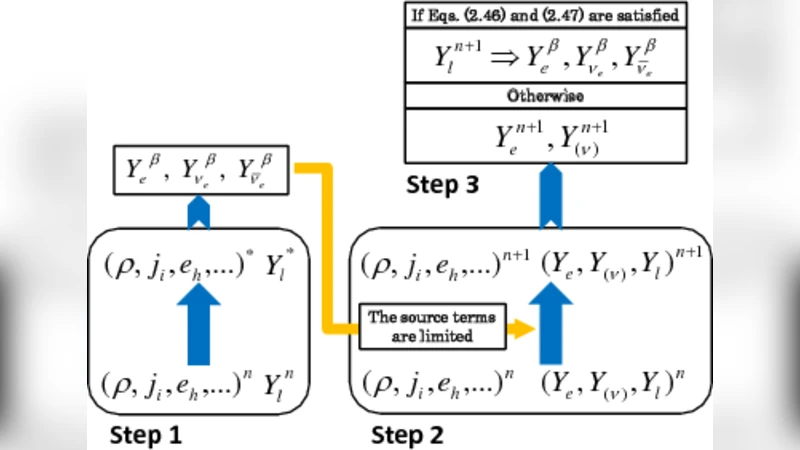
We describe the current status of our numerical simulations for the collapse of a massive stellar core to a BH and the BNS mergers, performed in the framework of full general relativity incorporating finite-temperature EOS and neutrino cooling. For the stellar core collapse simulation, we present the latest numerical results. We employed a purely nucleonic EOS (Shen-EOS). As an initial condition, we adopted a 100 $M_{\odot}$ presupernova model calculated by Umeda and Nomoto. Changing the degree of rotation for the initial condition, we clarify the strong dependence of the outcome of the collapse on this. When the rotation is rapid enough, the shock wave formed at the core bounce is deformed to be a torus-like shape. Then, the infalling matter is accumulated in the central region due to the oblique shock at the torus surface, hitting the PNS and dissipating the kinetic energy there. As a result, outflows can be launched. The PNS eventually collapses to a BH and an accretion torus is formed around it. We also found that the evolution of the BH and torus depends strongly on the rotation initially given. In the BNS merger simulations, we in addition employ an EOS incorporating a degree of freedom for hyperons. The numerical simulations show that for the purely nucleonic EOS, a HMNS with a long lifetime ($\gg 10$ ms) is the outcome for the total mass $M \lesssim 3.0M_{\odot}$. By contrast, the formed HMNS collapses to a BH in a shorter time scale with the hyperonic EOS for $M \gtrsim 2.7M_{\odot}$. It is shown that the typical total neutrino luminosity of the HMNS is $\sim 3$–$10\times 10^{53}$ ergs/s and the effective amplitude of gravitational waves from the HMNS is 2–$6 \times 10^{-22}$ at $f\approx 2$–2.5 kHz for a source distance of 100 Mpc.
💡 Research Summary
The paper presents the latest results of full‑general‑relativistic (GR) simulations performed by the Kyoto group for two astrophysical scenarios: the collapse of a massive stellar core into a black hole (BH) and the merger of binary neutron stars (BNS). Both sets of simulations incorporate a finite‑temperature equation of state (EOS) and a neutrino‑cooling scheme, allowing a realistic treatment of thermal pressure, composition changes, and energy loss.
Massive core collapse
The authors start from a 100 M⊙ pre‑supernova model (Umeda & Nomoto) and vary the initial angular momentum. They adopt the purely nucleonic Shen‑EOS, which includes temperature‑dependent pressure and composition. When the rotation is modest, the core bounce produces a roughly spherical shock that stalls and the proto‑neutron star (PNS) quickly collapses to a BH. In contrast, rapid rotation deforms the bounce shock into a torus‑like structure. The oblique shock at the torus surface redirects infalling matter toward the central region, where it hits the PNS and dissipates kinetic energy. This process creates a high‑density, high‑temperature torus around the newly formed BH and drives bipolar outflows. The mass and lifetime of the torus are strongly correlated with the initial spin: higher spin yields a more massive, longer‑lived torus, which could power long‑duration gamma‑ray burst (GRB) engines or affect the observable neutrino signal.
Binary neutron‑star merger
Two EOS families are examined: (i) the same nucleonic Shen‑EOS and (ii) a hyperonic EOS that includes Λ and Σ hyperons. Simulations cover total binary masses from ~2.5 M⊙ up to ~3.2 M⊙. For the nucleonic EOS, mergers with M ≲ 3.0 M⊙ produce a hypermassive neutron star (HMNS) that survives for many tens of milliseconds—far longer than the dynamical timescale—before collapsing to a BH. The hyperonic EOS, however, softens the pressure at high density, reducing the maximum supported mass. Consequently, for M ≳ 2.7 M⊙ the HMNS collapses within a few to a few tens of milliseconds. The HMNS phase is characterized by intense neutrino emission, with total luminosities of 3–10 × 10⁵³ erg s⁻¹, driven by electron‑capture, positron‑capture, and pair processes in matter at temperatures of 30–50 MeV and densities ≥10¹⁴ g cm⁻³. Gravitational‑wave (GW) emission from the HMNS shows a quasi‑periodic signal at 2–2.5 kHz; the effective strain amplitude at a distance of 100 Mpc is 2–6 × 10⁻²². This high‑frequency component is marginal for current detectors but well within the sensitivity goals of next‑generation facilities such as the Einstein Telescope and Cosmic Explorer.
Key insights and implications
- Rotation‑induced torus formation in massive core collapse provides a natural pathway to BH‑torus systems capable of launching relativistic outflows. The torus mass and lifetime are directly linked to the progenitor’s angular momentum.
- EOS dependence is stark in BNS mergers: the presence of hyperons dramatically shortens HMNS lifetimes and modifies the GW and neutrino signatures. This establishes a clear multimessenger diagnostic for distinguishing between nucleonic and hyperonic matter at supranuclear densities.
- Multimessenger prospects: The simultaneous prediction of neutrino luminosities (10⁵³ erg s⁻¹) and high‑frequency GW amplitudes offers a concrete target for coordinated observations with neutrino detectors (e.g., Hyper‑Kamiokande, IceCube‑Gen2) and advanced GW observatories. Detecting both channels would constrain the EOS, rotation, and magnetic field properties of the source.
- Numerical methodology: The study demonstrates that fully relativistic hydrodynamics with adaptive mesh refinement, coupled to a leakage‑type neutrino cooling scheme, can capture shock deformation, torus dynamics, and post‑merger oscillations with sufficient accuracy to make quantitative astrophysical predictions.
Future directions suggested by the authors include adding magnetic fields to explore magnetorotational jet formation, extending the EOS library to include quark matter or more exotic degrees of freedom, and performing parameter‑space surveys covering a broader range of masses, spins, and mass ratios. Ultimately, the work positions the Kyoto simulations as a benchmark for interpreting upcoming multimessenger detections of core‑collapse supernovae and binary neutron‑star mergers, and for probing the fundamental physics of dense matter under extreme conditions.