Canonizable Partial Order Generators and Regular Slice Languages
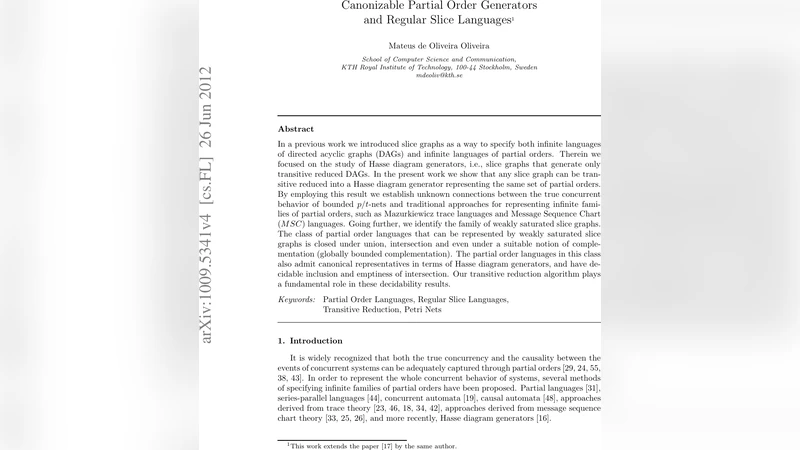
In a previous work we introduced slice graphs as a way to specify both infinite languages of directed acyclic graphs (DAGs) and infinite languages of partial orders. Therein we focused on the study of Hasse diagram generators, i.e., slice graphs that generate only transitive reduced DAGs, and showed that they could be used to solve several problems related to the partial order behavior of p/t-nets. In the present work we show that both slice graphs and Hasse diagram generators are worth studying on their own. First, we prove that any slice graph SG can be effectively transformed into a Hasse diagram generator HG representing the same set of partial orders. Thus from an algorithmic standpoint we introduce a method of transitive reducing infinite families of DAGs specified by slice graphs. Second, we identify the class of saturated slice graphs. By using our transitive reduction algorithm, we prove that the class of partial order languages representable by saturated slice graphs is closed under union, intersection and even under a suitable notion of complementation (cut-width complementation). Furthermore partial order languages belonging to this class can be tested for inclusion and admit canonical representatives in terms of Hasse diagram generators. As an application of our results, we give stronger forms of some results in our previous work, and establish some unknown connections between the partial order behavior of $p/t$-nets and other well known formalisms for the specification of infinite families of partial orders, such as Mazurkiewicz trace languages and message sequence chart (MSC) languages.
💡 Research Summary
The paper revisits the framework of slice graphs, a formalism introduced in earlier work for describing infinite families of directed acyclic graphs (DAGs) and the associated partial order (PO) languages. While the previous study focused mainly on Hasse diagram generators—slice graphs that already generate transitive‑reduced DAGs—the current work expands the scope by treating slice graphs themselves as first‑class objects and by providing systematic methods to convert any slice graph (SG) into an equivalent Hasse diagram generator (HG) that captures exactly the same set of partial orders.
The authors first present a deterministic transitive‑reduction algorithm. For each DAG generated by an SG, the algorithm identifies and removes redundant edges while preserving the reachability relation, thereby producing a Hasse diagram that is minimal with respect to transitivity. This transformation is effective: given any SG, one can construct an HG that generates the same PO language, thus enabling a compact representation of otherwise infinite families of DAGs.
Next, the paper defines the class of saturated slice graphs. A saturated SG contains, for every possible combination of slice labels, the corresponding transition, which makes its expressive power maximal within the slice‑graph paradigm. By applying the transitive‑reduction procedure to saturated SGs, the authors prove several closure properties: the PO languages generated by saturated SGs are closed under union, intersection, and a specially devised notion of complementation called cut‑width complementation. This mirrors the classic closure properties of regular languages but in the richer setting of infinite DAG families.
A major theoretical contribution is the establishment of decidable inclusion testing and the existence of canonical representatives for saturated PO languages. For any saturated PO language there exists a unique minimal Hasse diagram generator (canonical HG) that characterizes it. Consequently, language equivalence, inclusion, and minimisation become algorithmically tractable tasks, opening the door to automated verification techniques for systems modeled by slice graphs.
The authors then connect these results to well‑known concurrency formalisms. They show how the partial‑order behavior of p/t‑nets (Petri nets) can be captured by saturated SGs or their canonical HGs, thereby strengthening earlier results that related p/t‑nets to slice‑graph languages. Moreover, they construct explicit translations between saturated SGs and Mazurkiewicz trace languages as well as Message Sequence Chart (MSC) languages. These translations reveal previously unknown relationships: for instance, a Mazurkiewicz trace can be interpreted as a set of slice transitions, and an MSC’s message flow can be encoded as slice labels, after which transitive reduction yields a compact Hasse diagram representation. This unifies three major approaches to specifying infinite families of partial orders under a single algebraic umbrella.
Finally, the paper discusses practical implications. By reducing infinite DAG families to canonical Hasse diagrams, safety and liveness properties of p/t‑nets can be checked via inclusion tests on saturated SGs, often more efficiently than traditional token‑based analyses. The closure under cut‑width complementation also suggests modular composition and decomposition techniques for large concurrent systems, where components can be described by saturated SGs and combined while preserving decidability of verification problems.
In summary, the work delivers a comprehensive theory that (1) provides an effective algorithm to transitive‑reduce any slice graph, (2) identifies saturated slice graphs as a robust, closed class with decidable inclusion and canonical forms, and (3) bridges slice‑graph languages with established concurrency models such as Petri nets, Mazurkiewicz traces, and MSCs. These contributions significantly advance the formal understanding of infinite partial‑order languages and lay a solid foundation for future tool development in concurrent system verification.
Comments & Academic Discussion
Loading comments...
Leave a Comment