Quantisation commutes with reduction at discrete series representations of semisimple groups
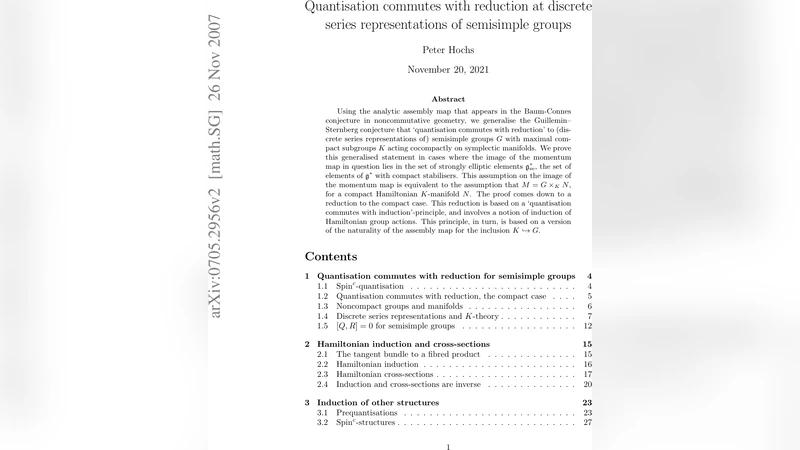
Using the analytic assembly map that appears in the Baum-Connes conjecture in noncommutative geometry, we generalise the $\Spin^c$-version of the Guillemin-Sternberg conjecture that quantisation commutes with reduction' to (discrete series representations of) semisimple groups $G$ with maximal compact subgroups $K$ acting cocompactly on symplectic manifolds. We prove this statement in cases where the image of the momentum map in question lies in the set of strongly elliptic elements, the set of elements of $\g^*$ with compact stabilisers. This assumption on the image of the momentum map is equivalent to the assumption that $M = G \times_K N$, for a compact Hamiltonian $K$-manifold $N$. The proof comes down to a reduction to the compact case. This reduction is based on a quantisation commutes with induction’-principle, and involves a notion of induction of Hamiltonian group actions. This principle, in turn, is based on a version of the naturality of the assembly map for the inclusion of $K$ into $G$.
💡 Research Summary
The paper extends the celebrated “quantisation commutes with reduction’’ principle, originally formulated for compact groups in the Spinⁿ‑setting, to the realm of non‑compact semisimple Lie groups that possess discrete series representations. The authors achieve this by exploiting the analytic assembly map that lies at the heart of the Baum‑Connes conjecture.
Setting and main hypothesis.
Let (G) be a real semisimple Lie group with maximal compact subgroup (K). Assume that (G) acts cocompactly on a symplectic manifold ((M,\omega)) and that the action is Hamiltonian with momentum map (\mu:M\to\mathfrak g^{}). The crucial hypothesis is that the image (\mu(M)) consists of strongly elliptic elements, i.e. points of (\mathfrak g^{}) whose stabilisers are compact. This condition is equivalent to the geometric decomposition
\
Comments & Academic Discussion
Loading comments...
Leave a Comment