Accuracy Bounds for Belief Propagation
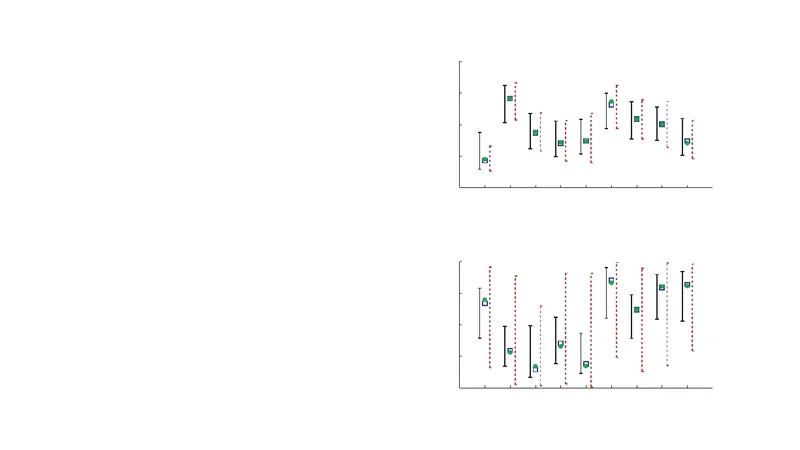
The belief propagation (BP) algorithm is widely applied to perform approximate inference on arbitrary graphical models, in part due to its excellent empirical properties and performance. However, little is known theoretically about when this algorithm will perform well. Using recent analysis of convergence and stability properties in BP and new results on approximations in binary systems, we derive a bound on the error in BP’s estimates for pairwise Markov random fields over discrete valued random variables. Our bound is relatively simple to compute, and compares favorably with a previous method of bounding the accuracy of BP.
💡 Research Summary
The paper “Accuracy Bounds for Belief Propagation” tackles a long‑standing gap in the theoretical understanding of belief propagation (BP) on general graphical models. While BP is known to be exact on trees, its performance on loopy graphs is only empirically justified, and rigorous error guarantees have been scarce. The authors combine recent convergence and stability analyses of BP with new approximation results for binary systems to derive a concrete, computable bound on the error of BP’s marginal estimates for pairwise Markov random fields (MRFs) with discrete variables.
The work begins by formalizing the pairwise MRF setting: each node holds a discrete random variable with domain size (d), and each edge ((i,j)) is associated with a potential matrix (\Phi_{ij}). BP iteratively passes messages that satisfy a fixed‑point equation. Leveraging recent results on the contractivity of the BP update operator, the authors show that the Jacobian of the message map has spectral radius (\rho < 1) under mild conditions, guaranteeing that message differences shrink geometrically with factor (\rho). This contractivity provides the foundation for bounding the propagation of any initial approximation error.
The central technical contribution is the extension of binary‑system approximation bounds—originally expressed as variational lower and upper bounds on the partition function—to arbitrary discrete domains. By defining the interaction strength (\lambda = \max_{(i,j)} \max_{a,b} |\Phi_{ij}(a,b)|) and the maximum degree (\Delta) of the graph, the authors construct an “error‑bound function”
\