Effective Potential for Ultracold Atoms at the Zero-Crossing of a Feshbach Resonance
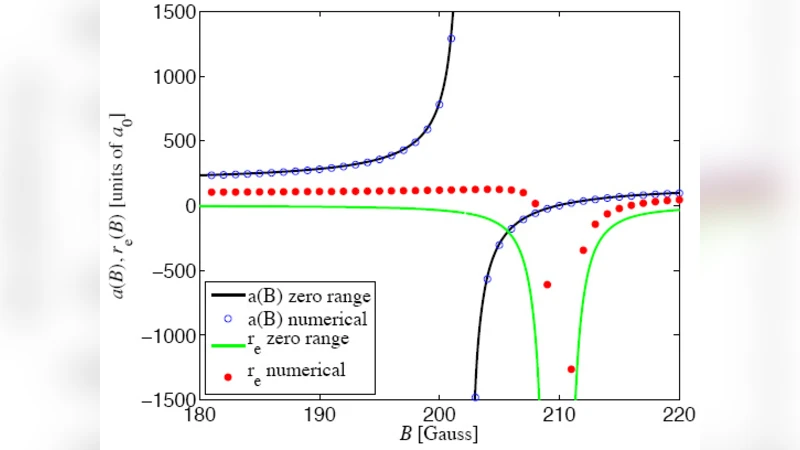
We consider finite-range effects when the scattering length goes to zero near a magnetically controlled Feshbach resonance. The traditional effective-range expansion is badly behaved at this point and we therefore introduce an effective potential that reproduces the full T-matrix. To lowest order the effective potential goes as momentum squared times a factor that is well-defined as the scattering length goes to zero. The potential turns out to be proportional to the background scattering length squared times the background effective range for the resonance. We proceed to estimate the applicability and relative importance of this potential for Bose-Einstein condensates and for two-component Fermi gases where the attractive nature of the effective potential can lead to collapse above a critical particle number or induce instability toward pairing and superfluidity. For broad Feshbach resonances the higher-order effect is completely negligible. However, for narrow resonances in tightly confined samples signatures might be experimentally accessible. This could be relevant for sub-optical wavelength microstructured traps at the interface of cold atoms and solid-state surfaces.
💡 Research Summary
The paper investigates the finite‑range physics that emerges when the s‑wave scattering length a is tuned to zero near a magnetically controlled Feshbach resonance, a point commonly referred to as the zero‑crossing. In the standard effective‑range expansion, the term –1/a diverges as a→0, rendering the expansion useless for describing low‑energy scattering in this regime. To overcome this difficulty, the authors construct an effective interaction that reproduces the full two‑body T‑matrix at all momenta. The resulting effective potential is non‑local and, to lowest order, proportional to the product of the incoming and outgoing momenta (k·k′). Its strength, denoted g₂, is given by g₂∝a_bg² r_bg, where a_bg is the background scattering length and r_bg the background effective range of the resonance. Crucially, g₂ remains finite when a→0, providing a well‑defined description of the interaction exactly at the zero‑crossing.
The authors then embed this momentum‑dependent interaction into many‑body theories for both Bose‑Einstein condensates (BECs) and two‑component Fermi gases. In a BEC, the Gross‑Pitaevskii equation acquires an additional term proportional to ∇²|ψ|², which modifies the equation of state and can shift the critical atom number for collapse. For a balanced Fermi mixture, the same term acts as an attractive correction to the usual contact interaction, enhancing pairing correlations. The analysis shows that, if the particle number exceeds a certain critical value, the attractive higher‑order term can drive a mechanical instability (collapse) or, alternatively, promote the formation of Cooper pairs and raise the superfluid transition temperature T_c.
A central part of the study is the comparison between broad and narrow resonances. For broad resonances the background parameters are small, making g₂ negligible; consequently the higher‑order contribution is far below experimental sensitivity. In contrast, narrow resonances feature a large background effective range and often a sizable a_bg, leading to a substantial g₂. The authors argue that in tightly confined geometries—such as sub‑optical‑wavelength microstructured traps or atom‑surface proximity experiments—typical momenta can be large enough that the k²‑dependent term becomes experimentally relevant. They provide estimates for trap frequencies, atom numbers, and confinement lengths where the collapse threshold or the shift in T_c could be observed.
Beyond specific applications, the paper emphasizes that the derived effective potential captures non‑local, finite‑range effects that are absent in the usual contact‑interaction models. This makes it a valuable tool for quantum‑simulation platforms where precise control over interaction shape is required, for designing atom‑based quantum information devices, and for studying atom‑surface interactions at the interface of cold‑atom and solid‑state physics.
In summary, the work presents a rigorous formulation of the interaction at the zero‑crossing of a Feshbach resonance, demonstrates its impact on the stability and superfluid properties of ultracold gases, and identifies realistic experimental regimes—particularly narrow resonances in strongly confined traps—where the higher‑order term could be detected. The findings open a pathway to explore subtle finite‑range physics in systems that were previously thought to be well described by simple contact interactions.
Comments & Academic Discussion
Loading comments...
Leave a Comment