Point configurations that are asymmetric yet balanced
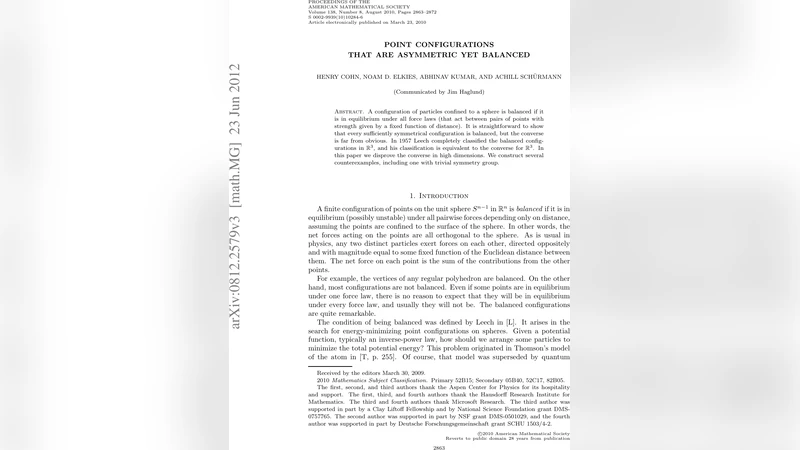
A configuration of particles confined to a sphere is balanced if it is in equilibrium under all force laws (that act between pairs of points with strength given by a fixed function of distance). It is straightforward to show that every sufficiently symmetrical configuration is balanced, but the converse is far from obvious. In 1957 Leech completely classified the balanced configurations in R^3, and his classification is equivalent to the converse for R^3. In this paper we disprove the converse in high dimensions. We construct several counterexamples, including one with trivial symmetry group.
💡 Research Summary
The paper investigates the relationship between symmetry and mechanical equilibrium for point configurations confined to the surface of a sphere. A configuration is called “balanced” if, for any pairwise interaction law whose strength depends only on the Euclidean distance between two points, the net force acting on each point vanishes. In low dimensions, especially in ℝ³, the situation is well understood: every highly symmetric configuration (regular polyhedra, Platonic solids, etc.) is automatically balanced, and Leech’s 1957 classification shows that, conversely, every balanced configuration in three‑dimensional space is one of these symmetric arrangements. The authors ask whether this converse holds in higher dimensions.
The first part of the paper formalises the notion of balance. Let S^{n‑1} be the unit sphere in ℝⁿ and let f :
Comments & Academic Discussion
Loading comments...
Leave a Comment