Dynamics of DNA Bubble in Viscous Medium
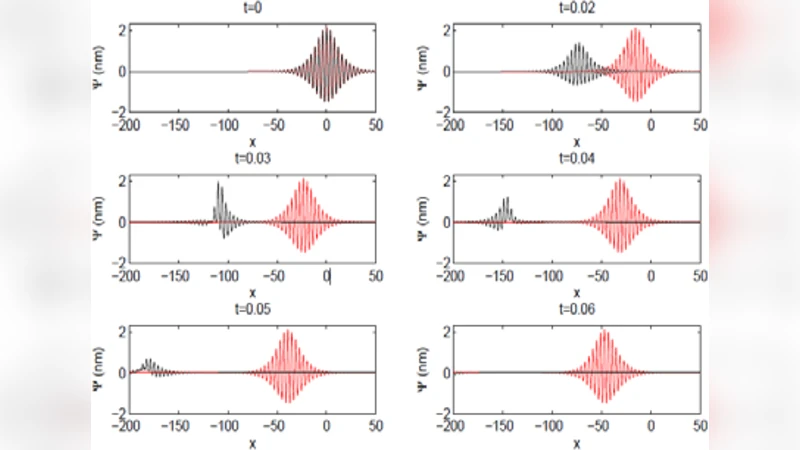
The damping effect to the DNA bubble is investigated within the Peyrard-Bishop model. In the continuum limit, the dynamics of the bubble of DNA is described by the damped nonlinear Schrodinger equation and studied by means of variational method. It is shown that the propagation of solitary wave pattern is not vanishing in a non-viscous system. Inversely, the solitary wave vanishes soon as the viscous force is introduced.
💡 Research Summary
The paper investigates how viscous damping influences the dynamics of a DNA “bubble” – a localized opening of the double helix – within the framework of the Peyrard‑Bishop (PB) model. Starting from the discrete PB Hamiltonian, which couples a Morse potential for the hydrogen bonds with a harmonic stacking interaction, the authors pass to the continuum limit by expanding the lattice variables into smooth fields u(x,t) and v(x,t). To incorporate the effect of a surrounding viscous medium (e.g., cytoplasm or nucleoplasm), they add a linear damping term γ∂u/∂t to the equations of motion, where γ is a phenomenological viscosity coefficient.
In the continuum description the coupled equations can be combined into a single complex envelope ψ(x,t) that obeys a damped nonlinear Schrödinger equation (damped NLS):
i ∂ψ/∂t + α ∂²ψ/∂x² + β |ψ|² ψ = i γ ψ.
Here α and β are constants derived from the original PB parameters, while the right‑hand side represents the viscous loss. The authors adopt a variational approach, choosing a trial soliton‑like ansatz
ψ(x,t)=A(t) sech
Comments & Academic Discussion
Loading comments...
Leave a Comment