CKP Hierarchy, Bosonic Tau Function and Bosonization Formulae
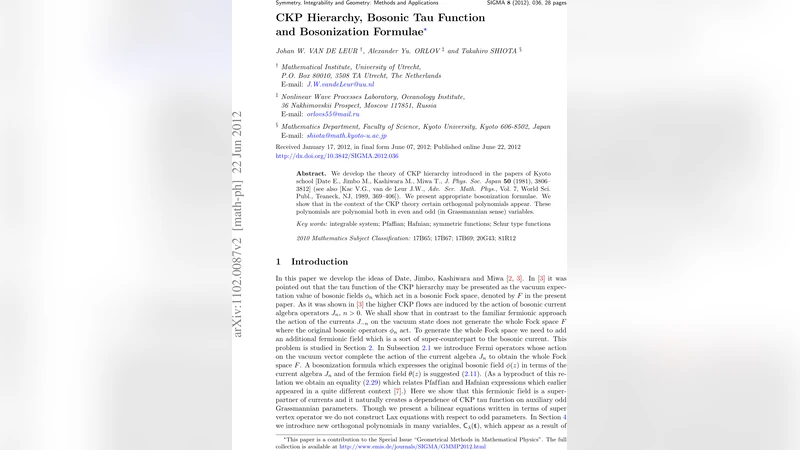
We develop the theory of CKP hierarchy introduced in the papers of Kyoto school [Date E., Jimbo M., Kashiwara M., Miwa T., J. Phys. Soc. Japan 50 (1981), 3806-3812] (see also [Kac V.G., van de Leur J.W., Adv. Ser. Math. Phys., Vol. 7, World Sci. Publ., Teaneck, NJ, 1989, 369-406]). We present appropriate bosonization formulae. We show that in the context of the CKP theory certain orthogonal polynomials appear. These polynomials are polynomial both in even and odd (in Grassmannian sense) variables.
💡 Research Summary
The paper provides a comprehensive development of the CK‑type Kadomtsev–Petviashvili (CKP) hierarchy, a reduction of the KP hierarchy characterized by the antisymmetric constraint on the Lax operator (L* = −L). Starting from the Sato Grassmannian description of KP, the authors restrict the infinite‑dimensional Grassmannian to a sub‑Grassmannian invariant under the C‑type involution, which forces the flow parameters to be odd only (tₖ with k∈2ℕ+1). This reduction halves the number of independent modes and yields a hierarchy whose Lax equations, Orlov–Schulman operators, and Hamiltonian structure are all compatible with the C‑type symmetry.
A central technical achievement is the explicit bosonization formula for the CKP hierarchy. The authors introduce neutral fermions ψ(z)=∑{n∈ℤ+½}ψₙz^{−n−½} and bosonic currents Jₖ=∑{n∈ℤ}:ψₙψ_{k−n}:, and prove the fundamental identity ψ(z)ψ(−z)=∂φ(z), where φ(z) is a bosonic field. Using the vacuum expectation value ⟨0|e^{H(t)}…|0⟩ with H(t)=∑{k odd}tₖJₖ, they convert any product of an even number of fermions into a Pfaffian of a matrix built from the two‑point function. Consequently the CKP tau‑function is defined as τ{CKP}(t)=⟨0|e^{H(t)}g|0⟩ with g∈O(∞), and it naturally takes a Pfaffian form rather than the determinant form familiar from KP.
When the group element g mixes even and odd (Grassmann) modes, the expansion of τ_{CKP} involves a new family of orthogonal polynomials Q_λ(t,ξ). These polynomials depend simultaneously on commuting “even” variables tₖ and anticommuting “odd” variables ξ_i. For a strict partition λ, Q_λ can be written as a Pfaffian of a skew‑symmetric matrix whose entries are elementary generating functions of the variables. The even part of Q_λ satisfies recursion relations analogous to those of classical orthogonal polynomials (Hermite, Laguerre, etc.), while the odd part reflects the antisymmetric nature of the Grassmann algebra. This construction generalizes the well‑known Schur Q‑functions, providing a super‑symmetric analogue appropriate for the CKP setting.
The bosonization machinery is then employed to derive the Hirota bilinear equation for the CKP hierarchy. Using the identity
⟨0|e^{H(t)}ψ(z)ψ(−z)|0⟩ = ∂zτ{CKP}(t) e^{∑{k odd}tₖz^{k}},
and performing a contour integral over z, the authors obtain the bilinear form
∮ dz z^{−1} e^{∑{k odd}(tₖ−t′ₖ)z^{k}} τ_{CKP}(t−
Comments & Academic Discussion
Loading comments...
Leave a Comment