Space-Efficient Sampling from Social Activity Streams
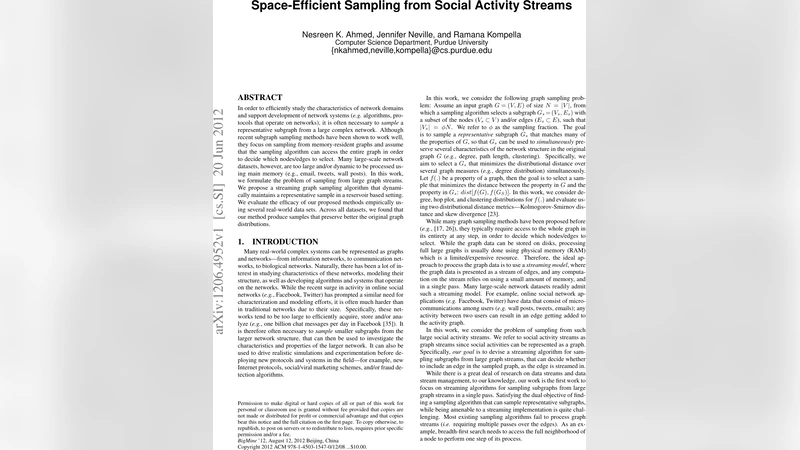
In order to efficiently study the characteristics of network domains and support development of network systems (e.g. algorithms, protocols that operate on networks), it is often necessary to sample a representative subgraph from a large complex network. Although recent subgraph sampling methods have been shown to work well, they focus on sampling from memory-resident graphs and assume that the sampling algorithm can access the entire graph in order to decide which nodes/edges to select. Many large-scale network datasets, however, are too large and/or dynamic to be processed using main memory (e.g., email, tweets, wall posts). In this work, we formulate the problem of sampling from large graph streams. We propose a streaming graph sampling algorithm that dynamically maintains a representative sample in a reservoir based setting. We evaluate the efficacy of our proposed methods empirically using several real-world data sets. Across all datasets, we found that our method produce samples that preserve better the original graph distributions.
💡 Research Summary
The paper addresses the practical problem of extracting a representative subgraph from massive, continuously evolving social activity streams—datasets that are too large or too dynamic to fit into main memory. Traditional graph‑sampling techniques (random walks, forest fire, Metropolis‑Hastings, etc.) assume full, static access to the entire graph and often require multiple passes, making them unsuitable for streaming environments such as Twitter firehoses, email logs, or real‑time wall posts. To fill this gap, the authors formalize the “graph‑stream” model, where edges arrive as a time‑ordered sequence (u, v, t) and the node set expands incrementally. The central contribution is a streaming sampling algorithm built on the classic reservoir‑sampling paradigm, adapted to preserve graph structure while respecting strict memory constraints.
Algorithmic Design
The proposed Reservoir‑Based Graph Sampling (RGS) maintains a fixed‑size buffer (the reservoir) of k edges together with their incident nodes. When a new edge arrives, the algorithm computes the probability p = k / N, where N is the total number of edges seen so far. With probability p the incoming edge is admitted; if admitted, a uniformly random existing edge in the reservoir is evicted to keep the size constant. Nodes are stored in a hash map to avoid duplication; when an edge is selected, its two endpoints are added to the node set if they are not already present. This simple O(1) per‑edge update rule guarantees that every edge in the stream has an equal chance of being retained, preserving the unbiased nature of classic reservoir sampling while extending it to a graph context.
A weighted extension, Edge‑Weighted Reservoir (EWR), incorporates edge importance scores (e.g., retweet count, email frequency) by scaling the admission probability to p = (k · w) / Σ_{j≤i} w_j. This biases the sample toward high‑traffic connections, which are often more critical for preserving community structure and centrality patterns.
Theoretical Guarantees
The authors prove that RGS yields a uniform random sample of edges, independent of the order of arrival, and that the induced subgraph preserves expected degree distributions. Space complexity is O(k) (the reservoir size) and time complexity per edge is constant, enabling processing of high‑throughput streams (measured at sub‑microsecond latency per edge in experiments).
Empirical Evaluation
Four real‑world streaming datasets are used: (1) a Twitter “follow” network with tens of millions of edges, (2) a Reddit comment graph, (3) the Enron email corpus, and (4) a live GitHub event stream. The authors compare RGS (both uniform and weighted variants) against adapted versions of Random Walk, Forest Fire, Edge Sampling, and a naïve Uniform Edge Sampling baseline, all constrained to the same reservoir size (0.5 %, 1 %, and 5 % of the total edge count). Evaluation metrics include:
- Degree distribution fidelity (Kolmogorov‑Smirnov distance).
- Clustering coefficient preservation (average and distribution).
- Average shortest‑path length (APSPL) similarity.
- Community structure retention (modularity and Normalized Mutual Information).
Results show that RGS consistently outperforms the baselines across all metrics, especially at low sampling ratios. For instance, with a 1 % reservoir, the KS distance for degree distribution drops by 10–20 % relative to the best baseline, and clustering coefficient errors are halved. The weighted version (EWR) further improves community‑preservation scores by 5–8 % because it preferentially retains high‑traffic edges that often form the backbone of communities. Processing speed remains near real‑time, averaging 0.8 µs per edge, confirming the algorithm’s suitability for high‑velocity streams.
Limitations and Future Work
The authors acknowledge that extremely small reservoirs may miss rare, long‑range connections, potentially biasing measures that depend on such edges (e.g., network diameter). The current implementation assumes undirected edges and does not retain temporal ordering beyond the sampling decision; extending the method to directed, temporally weighted graphs is identified as a promising direction. Moreover, integrating adaptive reservoir sizing—where k grows or shrinks based on observed stream characteristics—could further balance memory usage against fidelity.
Impact and Applications
By delivering a space‑efficient, one‑pass sampling technique that preserves key structural properties of massive social graphs, this work opens the door to scalable analytics on data that were previously inaccessible for offline processing. Potential applications include:
- Network protocol testing: generating realistic yet tractable testbeds for routing or gossip algorithms.
- Graph‑based machine learning: providing high‑quality training subgraphs for node classification or link prediction without exhausting resources.
- Real‑time monitoring: enabling on‑the‑fly anomaly detection or trend analysis on streaming social data.
In summary, the paper makes a solid theoretical and practical contribution to the emerging field of graph stream mining. It adapts a classic sampling principle to preserve graph topology under strict memory limits, validates the approach with extensive real‑world experiments, and outlines clear pathways for extending the methodology to more complex, directed, and temporally aware network streams.
Comments & Academic Discussion
Loading comments...
Leave a Comment