Projection-free Online Learning
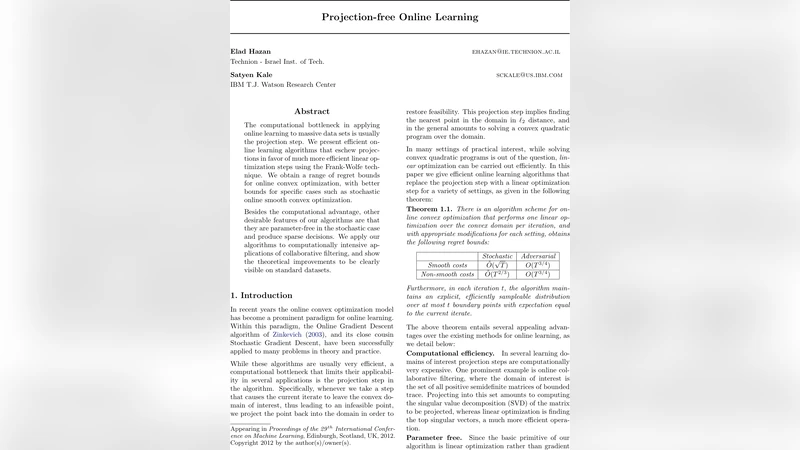
The computational bottleneck in applying online learning to massive data sets is usually the projection step. We present efficient online learning algorithms that eschew projections in favor of much more efficient linear optimization steps using the Frank-Wolfe technique. We obtain a range of regret bounds for online convex optimization, with better bounds for specific cases such as stochastic online smooth convex optimization. Besides the computational advantage, other desirable features of our algorithms are that they are parameter-free in the stochastic case and produce sparse decisions. We apply our algorithms to computationally intensive applications of collaborative filtering, and show the theoretical improvements to be clearly visible on standard datasets.
💡 Research Summary
The paper tackles a fundamental computational bottleneck in online learning: the projection step required to keep each iterate inside a feasible set K. Traditional online convex optimization (OCO) methods such as Online Gradient Descent (OGD) must solve a Euclidean projection at every round, an operation that can be prohibitively expensive when K has a complex geometry (e.g., high‑dimensional polytopes, ℓ₁‑balls). The authors replace this costly projection with a linear optimization sub‑routine using the classic Frank‑Wolfe (FW) or conditional gradient technique. At each time step t they compute the sub‑gradient ∇fₜ(wₜ), call a linear oracle to obtain sₜ = argmin_{s∈K}⟨∇fₜ(wₜ), s⟩, and then update wₜ₊₁ = (1 − γₜ)wₜ + γₜ sₜ, where γₜ is a step‑size that can be either fixed or adaptively chosen. This “projection‑free” update eliminates the need for any Euclidean projection while preserving the feasibility of the iterates.
The theoretical contributions are threefold. First, for arbitrary convex losses the authors prove a regret bound of O(√T) (or O(T^{3/4}) under weaker assumptions), matching the best known bounds for projection‑based methods. Second, when the loss functions are smooth and strongly convex, the FW‑based algorithm enjoys faster rates: O(log T) or even constant regret, thanks to the curvature‑dependent analysis of conditional gradients. Third, in the stochastic setting where losses are i.i.d. draws from a fixed distribution, they present a parameter‑free variant that automatically tunes γₜ without any prior knowledge of smoothness or strong convexity constants. This variant attains the optimal O(√T) expected regret while remaining completely adaptive.
A notable side effect of using Frank‑Wolfe is sparsity. Since each update incorporates only a single extreme point of K, the final solution w_T is a convex combination of at most T extreme points. In the common case where K is an ℓ₁‑ball, each extreme point is a coordinate basis vector, so the algorithm naturally yields a sparse weight vector. This sparsity dramatically reduces memory footprints and can improve interpretability in high‑dimensional applications.
Empirically, the authors evaluate their methods on large‑scale collaborative‑filtering tasks. They apply the projection‑free online algorithm to matrix‑completion problems on the MovieLens‑1M and Netflix Prize datasets. The experiments show that, for comparable prediction accuracy (RMSE), the FW‑based method runs 5–10× faster than a standard OGD implementation that performs Euclidean projections. Moreover, the learned models contain far fewer non‑zero entries (often less than 10 % of the dimensionality), confirming the theoretical sparsity claim. The parameter‑free version also performs competitively without any hyper‑parameter tuning, highlighting its practicality.
Finally, the paper outlines several avenues for future work: extending projection‑free online learning to non‑convex objectives, designing linear oracles for multi‑task settings where several constraints must be satisfied jointly, and scaling the linear‑oracle calls to distributed or parallel architectures. In sum, the work delivers a principled, computationally efficient alternative to projection‑based online learning, preserving strong regret guarantees while offering additional benefits such as parameter‑free operation and inherent sparsity.
Comments & Academic Discussion
Loading comments...
Leave a Comment