Latent Collaborative Retrieval
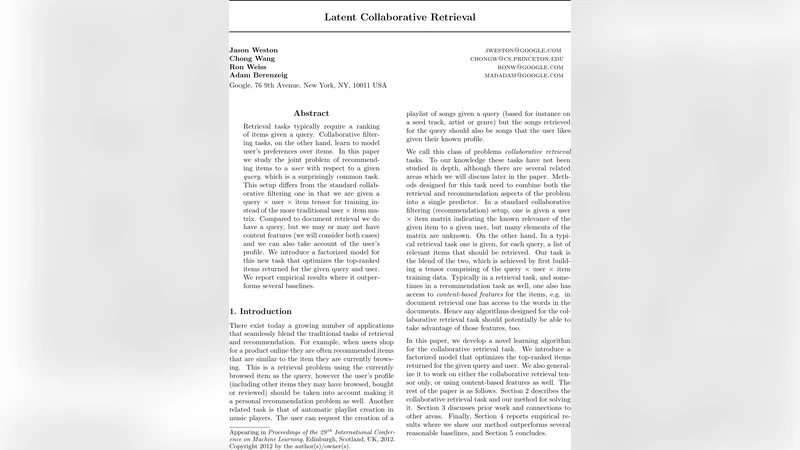
Retrieval tasks typically require a ranking of items given a query. Collaborative filtering tasks, on the other hand, learn to model user’s preferences over items. In this paper we study the joint problem of recommending items to a user with respect to a given query, which is a surprisingly common task. This setup differs from the standard collaborative filtering one in that we are given a query x user x item tensor for training instead of the more traditional user x item matrix. Compared to document retrieval we do have a query, but we may or may not have content features (we will consider both cases) and we can also take account of the user’s profile. We introduce a factorized model for this new task that optimizes the top-ranked items returned for the given query and user. We report empirical results where it outperforms several baselines.
💡 Research Summary
The paper introduces a novel recommendation problem that sits at the intersection of collaborative filtering (CF) and information retrieval (IR). In many real‑world services a user first issues a query (e.g., a search term) and then expects a personalized list of items that are both relevant to the query and tailored to his or her preferences. Traditional CF models only consider a user‑item interaction matrix and therefore cannot directly exploit the query context, while classic IR models match queries to documents without taking the user’s profile into account. To bridge this gap the authors define the “latent collaborative retrieval” (LCR) task, where the training data is a three‑dimensional tensor of the form user × query × item. Each entry indicates whether a particular user interacted with a particular item under a specific query.
Model architecture
The core of the proposed method is a tensor factorization that assigns a low‑dimensional latent vector to each user (U), each query (Q), and each item (I). The predicted relevance score for a triple (q, u, i) is the triple inner product:
\