Stellar Feedback in Galaxies and the Origin of Galaxy-scale Winds
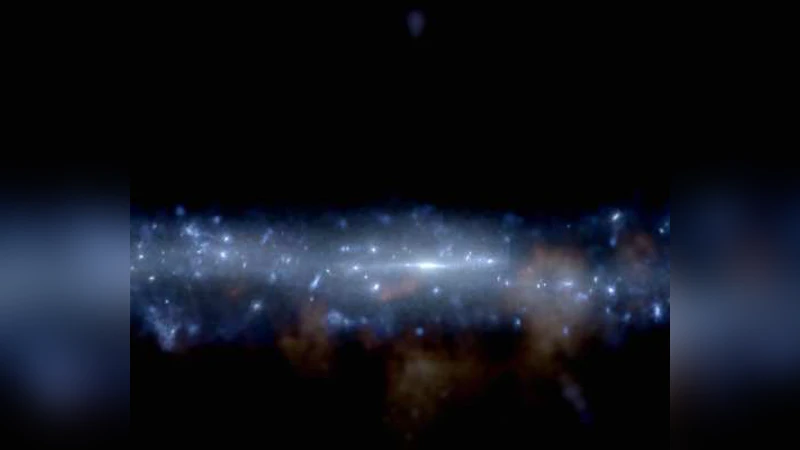
Feedback from massive stars is believed to play a critical role in driving galactic super-winds that enrich the IGM and shape the galaxy mass function and mass-metallicity relation. In previous papers, we introduced new numerical methods for implementing stellar feedback on sub-GMC through galactic scales in galaxy simulations. This includes radiation pressure (UV through IR), SNe (Type-I & II), stellar winds (‘fast’ O-star through ‘slow’ AGB winds), and HII photoionization. Here, we show that these feedback mechanisms drive galactic winds with outflow rates as high as 10-20 times the galaxy SFR. The mass-loading efficiency (wind mass loss rate divided by SFR) scales inversely with circular velocity, consistent with momentum-conservation expectations. We study the contributions of each feedback mechanism to galactic winds in a range of galaxy models, from SMC-like dwarfs & MW-analogues to z2 clumpy disks. In massive, gas-rich systems (local starbursts and high-z galaxies), radiation pressure dominates the wind generation. For MW-like spirals and dwarf galaxies the gas densities are much lower, and shock-heated gas from SNe and stellar winds dominates production of large-scale outflows. In all models, however, winds have a multi-phase structure that depends on interactions between multiple feedback mechanisms operating on different spatial & time scales: any single mechanism fails to reproduce the winds observed. We provide fitting functions for wind mass-loading and velocities as a function of galaxy properties, for use in cosmological simulations and semi-analytic models. These differ from typically-adopted formulae with explicit dependence on gas surface density that can be very important in both low-density dwarf galaxies and high-density gas-rich galaxies.
💡 Research Summary
In this paper Hopkins, Quataert, and Murray present a comprehensive study of galactic‑scale winds driven by stellar feedback, using high‑resolution smoothed‑particle hydrodynamics simulations that resolve the interstellar medium down to sub‑parsec scales. Building on their earlier “Paper I” and “Paper II”, the authors implement four feedback channels: (1) local momentum deposition from radiation pressure (including UV absorption and IR multiple scattering), (2) momentum and energy from Type I and Type II supernovae, (3) mechanical energy from stellar winds ranging from fast O‑star winds to slow AGB outflows, and (4) heating and pressure from H II region photo‑ionization. Stellar populations are modeled with a Kroupa IMF and STARBURST99, providing age‑ and metallicity‑dependent luminosities, mass‑loss rates, and supernova rates.
Four representative galaxy models are simulated: an SMC‑like dwarf, a Milky Way analogue, an LIRG‑type gas‑rich spiral (Sbc), and a high‑redshift massive starburst disk (HiZ). Each model includes a live dark halo, stellar bulge, gas and stellar disks, and realistic cooling down to <100 K, as well as a molecular fraction prescription. The simulations span from low‑resolution runs (∼3 × 10⁶ particles) to ultra‑high‑resolution runs (∼10⁹ particles) to test convergence.
The key results are:
-
Robust wind generation – All four galaxy types launch large‑scale outflows with mass‑loading factors η ≡ Ṁ_wind/Ṁ_* ranging from ∼10 to 20. The outflows are multi‑phase, containing cold (T ≲ 10⁴ K), warm (10⁴–10⁶ K), and hot (≳ 10⁶ K) components.
-
Scaling with circular velocity – The mass‑loading follows η ∝ V_c⁻¹, as expected from simple momentum‑conservation arguments when the total momentum injection from stars scales with the star‑formation rate. This scaling reproduces the empirical trends required to match the observed galaxy stellar mass function and the mass‑metallicity relation.
-
Dominant feedback channel depends on galaxy properties – In the high‑density, gas‑rich HiZ and Sbc models, infrared‑optically thick regions boost radiation pressure (via the (1 + τ_IR) factor) and it supplies the majority (≈60–80 %) of the wind momentum. In the lower‑density Milky Way and SMC models, radiation pressure is weak; instead, the hot bubbles generated by supernovae and fast stellar winds dominate the driving, providing both thermal pressure and additional momentum.
-
Multi‑phase wind structure arises from interaction of channels – Cold gas is primarily accelerated directly by radiation pressure, warm gas is entrained in shock‑driven shells from supernovae and winds, and hot gas fills the interiors of expanding bubbles. No single feedback mechanism can reproduce the observed velocity distributions or phase fractions; the combined, time‑dependent action of all channels is essential.
-
New fitting formulae for cosmological use – The authors derive empirical relations that include both circular velocity and gas surface density Σ_gas:
η ≈ α (V_c/100 km s⁻¹)⁻¹ (Σ_gas/10 M_⊙ pc⁻²)^{β}, with α ≈ 10 and β ≈ 0.3–0.5, and
v_wind ≈ γ V_c (Σ_gas/10 M_⊙ pc⁻²)^{δ}, with γ ≈ 2–3 and δ ≈ 0.1.
These relations improve upon the commonly used η ∝ V_c⁻¹ prescription by capturing the strong dependence on gas density that is crucial for dwarf galaxies and high‑z starbursts. -
Implications for galaxy formation theory – By demonstrating that realistic, multi‑channel stellar feedback naturally yields the high mass‑loading factors required to regulate star formation and eject baryons, the work resolves a long‑standing discrepancy in cosmological simulations that otherwise overproduce stellar masses, especially at low halo masses. The results also provide a physically motivated sub‑grid model for future large‑volume simulations and semi‑analytic models.
In summary, the paper shows that when radiation pressure, supernovae, stellar winds, and H II region heating are all modeled self‑consistently on sub‑GMC scales, galaxies of all masses generate powerful, multi‑phase winds whose mass‑loading scales inversely with circular velocity and depends sensitively on gas surface density. This comprehensive treatment offers a robust framework for incorporating realistic stellar feedback into galaxy formation models and deepens our understanding of how galaxies regulate their baryon content and enrich the intergalactic medium.
Comments & Academic Discussion
Loading comments...
Leave a Comment