The Structure of the Interstellar Medium of Star Forming Galaxies
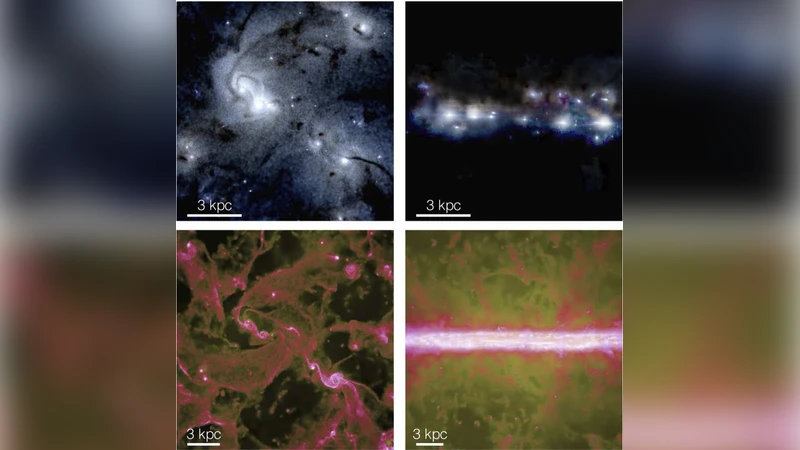
We present numerical methods for including stellar feedback in galaxy-scale simulations. We include heating by SNe (I & II), gas recycling and shock-heating from O-star & AGB winds, HII photoionization, and radiation pressure from stellar photons. The energetics and time-dependence are taken directly from stellar evolution models. We implement these in simulations with pc-scale resolution, modeling galaxies from SMC-like dwarfs and MW analogues to massive z2 starburst disks. Absent feedback, gas cools and collapses without limit. With feedback, the ISM reaches a multi-phase steady state in which GMCs continuously form, disperse, and re-form. Our primary results include: (1) Star forming galaxies generically self-regulate at Toomre Q1. Most of the volume is in diffuse hot gas with most of the mass in dense GMC complexes. The phase structure and gas mass at high densities are much more sensitive probes of stellar feedback physics than integrated quantities (Toomre Q or gas velocity dispersion). (2) Different feedback mechanisms act on different scales: radiation & HII pressure are critical to prevent runaway collapse of dense gas in GMCs. SNe and stellar winds dominate the dynamics of volume-filling hot gas; however this primarily vents out of the disk. (3) The galaxy-averaged SFR is determined by feedback. For given feedback efficiency, restricting star formation to molecular gas or modifying the cooling function has little effect; but changing feedback mechanisms directly translates to shifts off the Kennicutt-Schmidt relation. (4) Self-gravity leads to marginally-bound GMCs with an ~M^-2 mass function with a cutoff at the Jeans mass; they live a few dynamical times before being disrupted by stellar feedback and turn ~1-10% of their mass into stars (increasing from dwarfs through starburst galaxies). Low-mass GMCs are preferentially unbound.
💡 Research Summary
This paper presents a comprehensive suite of high‑resolution (≈1 pc) galaxy‑scale simulations that explicitly incorporate multiple stellar feedback processes. The authors implement heating and momentum injection from Type I and II supernovae, gas recycling and shock heating from both early massive‑star winds and late AGB winds, photo‑ionization heating from H II regions, and radiation pressure from stellar photons (both local IR multi‑scattering and long‑range UV/IR pressure). All energetics and time‑dependence are taken directly from stellar evolution models (e.g., STARBURST99), ensuring a physically motivated coupling between young stellar populations and the surrounding interstellar medium (ISM).
Four representative galaxy models are simulated: an SMC‑mass dwarf, a Milky‑Way analogue, an Sbc‑type gas‑rich starburst, and a high‑redshift (z ≈ 2) massive starburst (HiZ). In the absence of feedback, gas cools rapidly, collapses without limit, and converts nearly all its mass into stars, contradicting observations. When the full suite of feedback is active, the ISM self‑regulates to a quasi‑steady, multi‑phase state: most of the volume is filled with hot (∼10⁶ K), low‑density gas, while most of the mass resides in dense giant molecular clouds (GMCs). The disk maintains a Toomre Q≈1, and the gas velocity dispersion (10–30 km s⁻¹) matches observed values.
The study dissects the role of each feedback channel. Radiation pressure and H II gas pressure dominate on small scales (densities ≳10² cm⁻³) and are essential for halting runaway collapse inside GMCs. They limit the star formation efficiency within a cloud to a few percent, disrupting clouds after only a few dynamical times. Supernovae and stellar winds dominate the dynamics of the diffuse hot phase; they generate high‑pressure bubbles that vent out of the disk, contributing modestly to the mid‑plane pressure but driving galactic‑scale outflows. The authors find that the galaxy‑averaged star formation rate (SFR) is set by the overall feedback efficiency: altering the feedback prescription shifts galaxies off the Kennicutt–Schmidt relation, whereas merely changing the molecular gas prescription or cooling function has little impact.
GMCs emerging in the simulations exhibit a mass function dN/dM ∝ M⁻² with a high‑mass cutoff set by the Jeans/Toomre mass of the host galaxy. Typical GMC lifetimes are a few dynamical times (≈10–30 Myr). The integrated star formation efficiency per cloud ranges from ∼1 % in dwarf and Milky‑Way‑like disks to ∼10 % in the most gas‑rich, high‑z starbursts. Low‑mass clouds tend to be unbound, while more massive clouds are marginally bound (virial parameter near unity) but display a wide dispersion. The simulations also test three molecular chemistry models; all produce similar global SFRs, confirming that dynamical feedback, rather than detailed H₂ formation physics, controls star formation in these systems.
By systematically turning off individual feedback channels, the authors demonstrate that without radiation pressure the clouds collapse to very high densities before supernovae explode, leading to unrealistically high SFRs. Conversely, supernovae alone cannot prevent collapse in dense regions, underscoring the necessity of multi‑scale, multi‑physics feedback. The paper thus provides a unified framework that simultaneously reproduces (i) the observed multi‑phase ISM structure, (ii) the self‑regulated Q≈1 disk stability, (iii) realistic GMC mass spectra and lifetimes, and (iv) the global Kennicutt–Schmidt relation across a wide range of galaxy masses and redshifts.
In summary, Hopkins, Quataert, and Murray demonstrate that a physically motivated, comprehensive feedback model is essential for realistic galaxy formation simulations. Their results clarify how different feedback mechanisms operate on distinct spatial and density scales, how they collectively regulate star formation, and how they shape the statistical properties of GMCs and the ISM. This work sets a new benchmark for future cosmological and galaxy‑scale simulations aiming to capture the interplay between star formation and feedback.
Comments & Academic Discussion
Loading comments...
Leave a Comment