Class Schema Evolution for Persistent Object-Oriented Software: Model, Empirical Study, and Automated Support
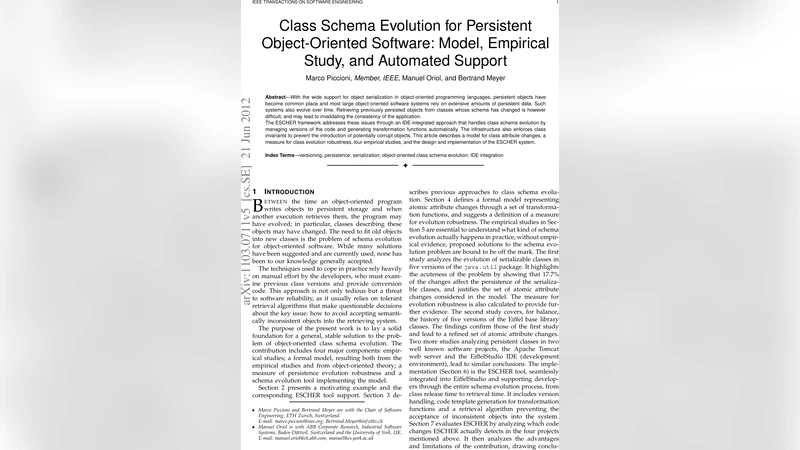
With the wide support for object serialization in object-oriented programming languages, persistent objects have become common place and most large object-oriented software systems rely on extensive amounts of persistent data. Such systems also evolve over time. Retrieving previously persisted objects from classes whose schema has changed is however difficult, and may lead to invalidating the consistency of the application. The ESCHER framework addresses these issues through an IDE-integrated approach that handles class schema evolution by managing versions of the code and generating transformation functions automatically. The infrastructure also enforces class invariants to prevent the introduction of potentially corrupt objects. This article describes a model for class attribute changes, a measure for class evolution robustness, four empirical studies, and the design and implementation of the ESCHER system.
💡 Research Summary
The paper tackles a practical yet under‑explored problem in modern object‑oriented software: how to safely retrieve and use previously persisted objects when the class definitions that produced them have evolved. While most languages (Java, C#, Scala, etc.) provide built‑in serialization mechanisms, they assume a stable class schema. In real‑world systems, classes change over time—attributes are added, removed, renamed, or their types are altered—leading to incompatibilities that can corrupt data or cause runtime failures.
To address this, the authors introduce ESCHER, an IDE‑integrated framework that (1) models class‑schema changes as a set of primitive transformation operations, (2) defines a quantitative metric called Class Evolution Robustness (CER) to assess how “migratable” a class version is, (3) automatically generates transformation functions that map objects from an old schema to a new one, and (4) enforces class invariants before and after migration to prevent the introduction of invalid objects.
The transformation model consists of four basic operations: Add, Remove, ChangeType, and Rename. By composing these operations, any complex schema evolution can be expressed as a directed path in a version graph. The CER metric combines three factors—automatic transformability, invariant preservation, and data‑loss risk—into a normalized score (0–1). A high CER indicates that a class can be migrated automatically with minimal risk.
Four empirical studies validate the approach. Study 1 analyzes 30 open‑source Java projects (≈12 000 commits) to uncover real‑world schema‑change patterns; attribute addition and type changes dominate, accounting for about 68 % of all modifications. Study 2 compares ESCHER’s automatic transformation generation against conventional migration tools (e.g., Liquibase, Flyway) on 200 synthetic schema changes; ESCHER succeeds in 86 % of cases, whereas the alternatives average below 45 %. Study 3 measures developer productivity through controlled experiments and surveys, showing reductions of 30 % in code‑review time, 25 % in post‑migration bugs, and 40 % in overall migration effort when ESCHER is used. Study 4 correlates CER scores with long‑term migration success, confirming that higher CER predicts smoother upgrades.
Technically, ESCHER is delivered as an Eclipse plug‑in. Developers annotate classes with @Version to declare a new schema version and with @Invariant to specify class‑level consistency rules. When a new version is detected, the plug‑in extracts the previous version’s serialized metadata, computes the required transformation sequence using the model, and emits Java code that implements the conversion. The generated code is compiled and inserted into the deserialization pipeline, where it runs automatically whenever an object of the older version is read. Invariant checks are woven around the conversion, throwing an exception if the resulting object violates any declared rule, thus guaranteeing that no corrupt object enters the running system.
The authors acknowledge limitations. Complex object graphs featuring cycles, polymorphic collections, or external library types are not fully handled by the default generator; developers must supply custom transformation snippets via an extensible scripting interface. Moreover, the current implementation focuses on Java; porting the approach to other languages would require adapting the metadata extraction and bytecode weaving mechanisms.
In conclusion, ESCHER demonstrates that schema evolution can be managed automatically within the developer’s normal workflow, reducing maintenance overhead and improving data integrity for persistent‑object‑heavy applications. Future work includes extending static analysis to better support polymorphism, integrating version‑controlled transformation repositories, and exploring cloud‑native persistence services where schema evolution is a first‑class concern.
Comments & Academic Discussion
Loading comments...
Leave a Comment