An Analytic Model of Angular Momentum Transport by Gravitational Torques: From Galaxies to Massive Black Holes
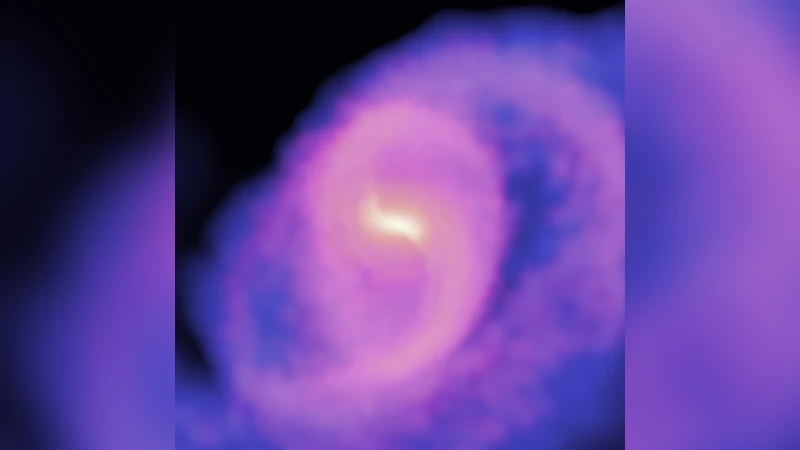
We present analytic calculations of angular momentum transport and gas inflow in galaxies, from scales of ~kpc to deep in the potential of a central black hole (BH). We compare these analytic calculations to numerical simulations and use them to develop a sub-grid model of BH growth that can be incorporated into semi-analytic models or cosmological simulations. Both analytic calculations and simulations argue that the strongest torque on gas arises when non-axisymmetric perturbations to the stellar gravitational potential produces orbit crossings and shocks in the gas. This is true both at large radii ~0.01-1 kpc, where bar-like modes dominate the non-axisymmetric potential, and at smaller radii <10 pc, where a lopsided/eccentric disk dominates. The traditional orbit crossing criterion is not always adequate to predict the locations of, and inflow due to, shocks in gas+stellar disks with finite sound speeds. We derive a modified criterion that predicts the presence of shocks in stellar dominated systems even absent formal orbit crossing. We then derive analytic expressions for the loss of angular momentum and the resulting gas inflow rates in the presence of such shocks. We test our analytic predictions using hydrodynamic simulations at a range of galactic scales, and show that they successfully predict the mass inflow rates and quasi-steady gas surface densities with small scatter (0.3 dex). We use our analytic results to construct a new estimate of the BH accretion rate given galaxy properties at larger radii. This captures the key scalings in the numerical simulations. Alternate estimates such as the local viscous accretion rate or the spherical Bondi rate fail systematically to reproduce the simulations.
💡 Research Summary
This paper develops a unified analytic framework for angular‑momentum transport and gas inflow from kiloparsec‑scale galactic disks down to the immediate sphere of influence of a central super‑massive black hole (SMBH). The authors argue that the dominant torque on the gas arises whenever a non‑axisymmetric stellar potential—generated by a bar‑like (m = 2) mode at ∼0.01–1 kpc or a lopsided/eccentric (m = 1) disk at <10 pc—induces orbit crossings and shocks in the gaseous component. Traditional orbit‑crossing criteria, which assume an infinitesimally cold fluid, fail when the gas has a finite sound speed. To remedy this, the authors derive a modified crossing condition that incorporates the ratio of the induced radial velocity perturbation to the sound speed, showing that shocks can develop even without formal orbit crossing in stellar‑dominated potentials.
Using this condition, they calculate the angular‑momentum loss per unit radius and obtain an analytic inflow rate \
Comments & Academic Discussion
Loading comments...
Leave a Comment