Metric inequalities for polygons
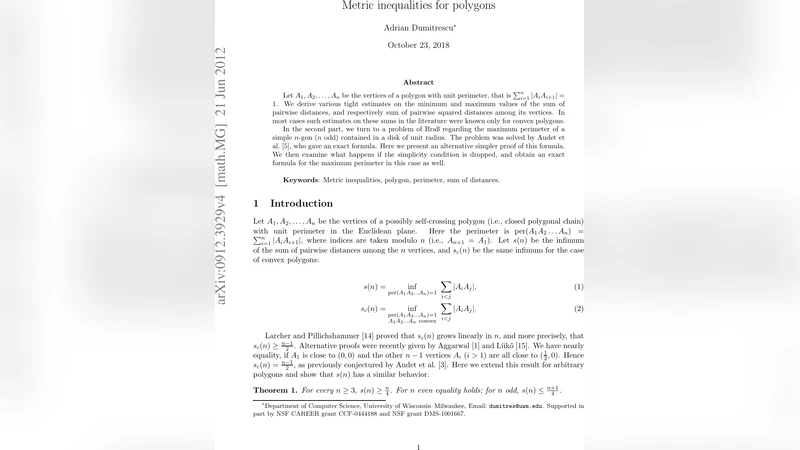
Let $A_1,A_2,…,A_n$ be the vertices of a polygon with unit perimeter, that is $\sum_{i=1}^n |A_i A_{i+1}|=1$. We derive various tight estimates on the minimum and maximum values of the sum of pairwise distances, and respectively sum of pairwise squared distances among its vertices. In most cases such estimates on these sums in the literature were known only for convex polygons. In the second part, we turn to a problem of Bra\ss\ regarding the maximum perimeter of a simple $n$-gon ($n$ odd) contained in a disk of unit radius. The problem was solved by Audet et al. \cite{AHM09b}, who gave an exact formula. Here we present an alternative simpler proof of this formula. We then examine what happens if the simplicity condition is dropped, and obtain an exact formula for the maximum perimeter in this case as well.
💡 Research Summary
The paper is divided into two main sections, each addressing a distinct geometric optimization problem.
In the first part the authors consider an n‑gon whose side lengths sum to one (unit perimeter) and study two global quantities: the sum of all pairwise distances
(S_{1}=\sum_{1\le i<j\le n}|A_{i}A_{j}|)
and the sum of all pairwise squared distances
(S_{2}=\sum_{1\le i<j\le n}|A_{i}A_{j}|^{2}).
While earlier work dealt almost exclusively with convex polygons, this article extends the analysis to arbitrary (possibly non‑convex and self‑intersecting) polygons. By first treating the extremal configurations for triangles and quadrilaterals, the authors then set up a continuous optimization problem for general n. Using Lagrange multipliers together with elementary trigonometric identities they show that the maximal values are attained when the vertices lie on a common circle and are equally spaced. In that configuration each edge subtends an angle (\pi/n) at the centre, which yields the explicit formulas
\
Comments & Academic Discussion
Loading comments...
Leave a Comment