Active Learning Using Smooth Relative Regret Approximations with Applications
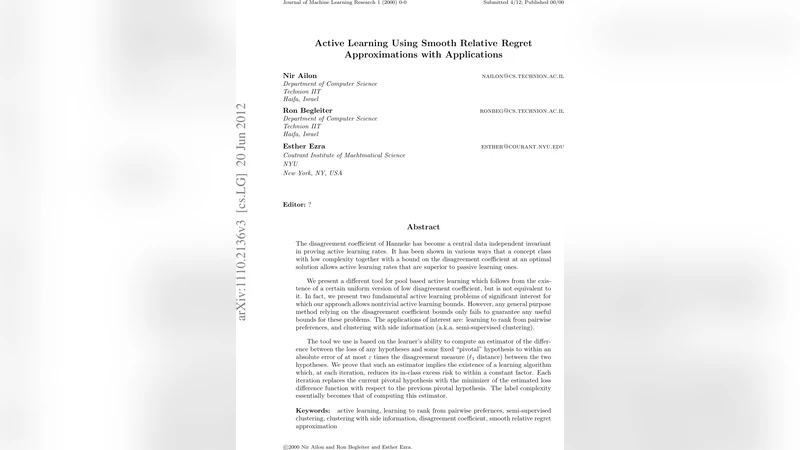
The disagreement coefficient of Hanneke has become a central data independent invariant in proving active learning rates. It has been shown in various ways that a concept class with low complexity together with a bound on the disagreement coefficient at an optimal solution allows active learning rates that are superior to passive learning ones. We present a different tool for pool based active learning which follows from the existence of a certain uniform version of low disagreement coefficient, but is not equivalent to it. In fact, we present two fundamental active learning problems of significant interest for which our approach allows nontrivial active learning bounds. However, any general purpose method relying on the disagreement coefficient bounds only fails to guarantee any useful bounds for these problems. The tool we use is based on the learner’s ability to compute an estimator of the difference between the loss of any hypotheses and some fixed “pivotal” hypothesis to within an absolute error of at most $\eps$ times the
💡 Research Summary
The paper introduces a novel tool for pool‑based active learning called Smooth Relative Regret Approximation (SRRA), which serves as an alternative and complement to the well‑known disagreement coefficient framework pioneered by Hanneke. While the disagreement coefficient θ (and its uniform version) has been central to proving that low‑complexity hypothesis classes can achieve active learning rates superior to passive learning, existing algorithms that rely solely on θ typically require explicit maintenance of a shrinking version space. This dependence makes them fragile: any error in estimating the version space can cause the algorithm to fail, and for many natural problems the disagreement coefficient can be prohibitively large, leading to vacuous query‑complexity bounds.
SRRA sidesteps these issues by fixing a “pivotal” hypothesis h and approximating, for every other hypothesis h′, the loss difference (relative regret) reg_h(h′)=er_D(h′)−er_D(h). An (ε,μ)‑SRRA is a function f such that |f(h′)−reg_h(h′)| ≤ ε·dist(h,h′)+μ for all h′, where dist is the ℓ₁ disagreement distance. The parameter ε controls the approximation quality, while μ accounts for a small bias that vanishes as the pool size grows. The key theoretical contribution (Theorem 3) shows that if such an estimator exists, then selecting h₁ = argmin_{h′} f(h′) yields a new hypothesis whose error satisfies er_D(h₁) ≤ (1+O(ε))·ν + O(ε·er_D(h)) + O(εμ), where ν is the optimal error. Consequently, iterating this step (Algorithm 1) reduces the excess risk geometrically without ever constructing a version space. Corollary 4 formalizes the convergence: after T iterations the error is (1+O(ε))·ν + O(ε^T·er_D(h₀)) + O(εμ).
The authors then demonstrate how to construct an (ε,μ)‑SRRA when the uniform disagreement coefficient θ is finite and the hypothesis class has VC‑dimension d. They partition the instance space into annuli X_i defined by disagreement regions of balls B(h, μ·2^i). For each annulus they draw O(ε⁻²·θ·(d·logθ + log(1/δ))) random labeled examples, compute empirical estimates f_i(h′) of the loss difference restricted to X_i, and set f = Σ_i f_i. Using relative ε‑approximation results (Haussler, Li et al.) they prove that with probability ≥1−δ the combined estimator satisfies the SRRA definition uniformly over all hypotheses. The sample complexity scales linearly with θ and d, and logarithmically with the desired precision, showing that SRRA is efficiently obtainable whenever the disagreement coefficient is small.
Two concrete applications illustrate the power of SRRA beyond what disagreement‑coefficient‑only analyses can achieve.
-
Learning to Rank from Pairwise Preferences (LRPP). Here the hypothesis class consists of permutations over n items, and the loss is the fraction of incorrectly ordered pairs. The disagreement coefficient for this problem grows linearly with n, making standard active‑learning bounds useless. By constructing an SRRA, the authors obtain a query complexity of O(θ·log n) (essentially O(log n) when θ is constant), dramatically improving over passive learning which would require Θ(n²) labeled pairs.
-
Clustering with Side Information (Semi‑Supervised Clustering). The learner receives pairwise “must‑link” or “cannot‑link” constraints. The disagreement coefficient can be as large as the number of clusters k, again leading to poor guarantees. Using SRRA, the algorithm focuses queries on the disagreement regions between clusters, achieving a label complexity of O(k·log n) to recover a clustering whose error is within a constant factor of the optimal.
Both cases demonstrate that SRRA can exploit the structure of the loss function and the geometry of the hypothesis class to concentrate queries where they are most informative, whereas disagreement‑coefficient‑based methods would require labeling essentially the whole pool.
In summary, the paper establishes SRRA as a robust, data‑independent tool that (i) can be derived from a bounded uniform disagreement coefficient, (ii) yields active‑learning algorithms that avoid explicit version‑space maintenance, and (iii) provides substantially better label‑complexity bounds for important problems such as ranking and semi‑supervised clustering. The authors also discuss practical considerations, including how to approximate the required empirical risk minimization via convex relaxations when exact ERM is computationally hard, and suggest future directions such as extending the analysis to richer noise models, multi‑class settings, and adaptive selection of ε and μ.
Comments & Academic Discussion
Loading comments...
Leave a Comment