Enhanced active power filter control for nonlinear non-stationary reactive power compensation
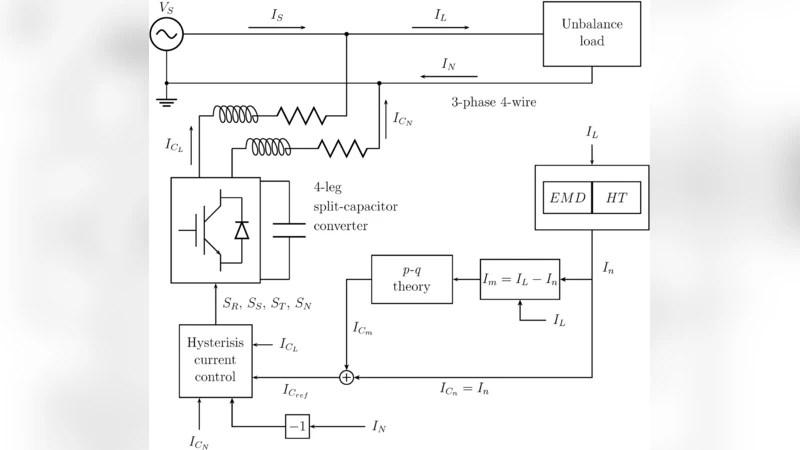
This paper describes a method to implement Reactive Power Compensation (RPC) in power systems that possess nonlinear non-stationary current disturbances. The Empirical Mode Decomposition (EMD) introduced in the Hilbert-Huang Transform (HHT) is used to separate the disturbances from the original current waveform. These disturbances are subsequently removed. Following that, Power Factor Correction (PFC) based on the well-known p-q power theory is conducted to remove the reactive power. Both operations were implemented in a shunt Active Power Filter (APF). The EMD significantly simplifies the singulation and the removal of the current disturbances. This helps to effectively identify the fundamental current waveform. Hence, it simplifies the implementation of RPC on nonlinear non-stationary power systems.
💡 Research Summary
The paper presents an integrated control strategy for shunt active power filters (APFs) that simultaneously addresses nonlinear, non‑stationary current disturbances and reactive power compensation (RPC) in modern power systems. Traditional RPC techniques, largely based on the instantaneous p‑q power theory, assume that the fundamental component of the load current can be readily identified. This assumption breaks down when the current waveform contains high‑frequency harmonics generated by nonlinear loads and irregular, time‑varying disturbances caused by load transients, faults, or switching events. In such conditions, the fundamental component is obscured, leading to inaccurate reactive‑power estimation and poor compensation performance.
To overcome this limitation, the authors incorporate Empirical Mode Decomposition (EMD), a core component of the Hilbert‑Huang Transform (HHT), as a preprocessing step. EMD adaptively decomposes a raw current signal into a finite set of Intrinsic Mode Functions (IMFs) without requiring a priori basis functions. Each IMF captures oscillatory modes at distinct time‑frequency scales, allowing the algorithm to isolate high‑frequency harmonics and irregular disturbance components from the underlying fundamental waveform. By discarding the IMFs identified as disturbances and reconstructing the signal from the remaining IMFs, a clean fundamental current is obtained while preserving the original voltage waveform.
With the fundamental current restored, the conventional p‑q theory is applied to compute instantaneous active (P) and reactive (Q) power components. The reactive‑power component is then used to generate a compensation current that, when injected by the APF, cancels the unwanted Q. The overall compensation current injected by the APF therefore consists of two parts: (1) a disturbance‑cancellation current derived from the EMD‑based separation, and (2) a reactive‑power cancellation current derived from the p‑q theory. Both currents are synthesized in real time and fed to the inverter of the shunt APF, which injects them into the network to restore a sinusoidal, unity‑power‑factor condition.
The authors validate the approach using a simulation environment that combines a nonlinear load (a power‑electronic converter) with artificially generated non‑stationary disturbances (random pulse currents). Two scenarios are compared: (i) conventional p‑q‑based compensation without disturbance removal, and (ii) the proposed EMD‑enhanced APF control. Results show that after EMD processing the reconstructed current matches the true fundamental with a negligible error. Total Harmonic Distortion (THD) of the line current drops from about 12 % to below 3 %, and the reactive power Q is reduced from approximately 0.8 kVAR to less than 0.1 kVAR. The power factor improves from 0.95 to 0.99, demonstrating that the method effectively restores both waveform quality and reactive‑power balance.
A discussion on computational complexity acknowledges that classic EMD requires iterative sifting, peak‑to‑valley interpolation, and envelope averaging, which can be demanding for real‑time implementation. However, the authors argue that modern digital signal processors (DSPs) and field‑programmable gate arrays (FPGAs) can meet the required processing rates, especially when optimized with parallel sifting or by employing ensemble‑based variants such as Ensemble EMD (EEMD) or Complete Ensemble EMD with Adaptive Noise (CEEMDAN) to mitigate mode‑mixing issues. The paper also notes that the integrated approach reduces hardware redundancy because a single APF handles both disturbance removal and reactive‑power compensation, lowering overall system cost and complexity.
In conclusion, the study contributes a practical solution for power‑quality improvement in grids populated with nonlinear and time‑varying loads. By leveraging EMD to extract the true fundamental current before applying the well‑established p‑q theory, the authors bridge the gap between disturbance‑rich real‑world conditions and the assumptions underlying conventional RPC methods. The experimental evidence confirms significant reductions in harmonic distortion, reactive power, and power‑factor deviation. Future work is suggested to explore large‑scale deployment, coordinated control among multiple APFs, and the integration of adaptive or machine‑learning‑based IMF selection to further enhance robustness and scalability.