Some considerations on the nonabelian tensor square of crystallographic groups
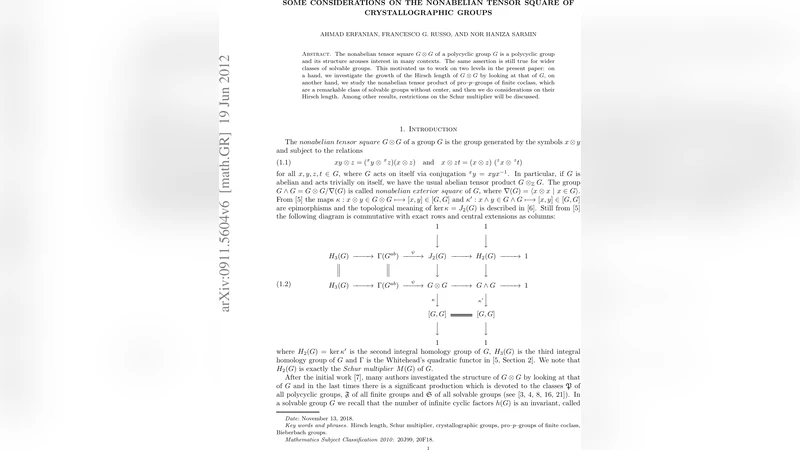
The nonabelian tensor square $G\otimes G$ of a polycyclic group $G$ is a polycyclic group and its structure arouses interest in many contexts. The same assertion is still true for wider classes of solvable groups. This motivated us to work on two levels in the present paper: on a hand, we investigate the growth of the Hirsch length of $G\otimes G$ by looking at that of $G$, on another hand, we study the nonabelian tensor product of pro–$p$–groups of finite coclass, which are a remarkable class of solvable groups without center, and then we do considerations on their Hirsch length. Among other results, restrictions on the Schur multiplier will be discussed.
💡 Research Summary
The paper investigates the non‑abelian tensor square (G\otimes G) of two important families of solvable groups: crystallographic (polycyclic) groups and pro‑(p) groups of finite coclass. The authors begin by recalling that for any polycyclic group (G) the tensor square is again polycyclic, a fact that extends to broader classes of solvable groups. Their first line of inquiry concerns the growth of the Hirsch length (h(G)) when passing to the tensor square. For a crystallographic group, which can be written as a semidirect product (\mathbb{Z}^n\rtimes F) with a finite group (F), the Hirsch length of the original group is simply (n). By exploiting the well‑known decomposition \
Comments & Academic Discussion
Loading comments...
Leave a Comment