Finite closed coverings of compact quantum spaces
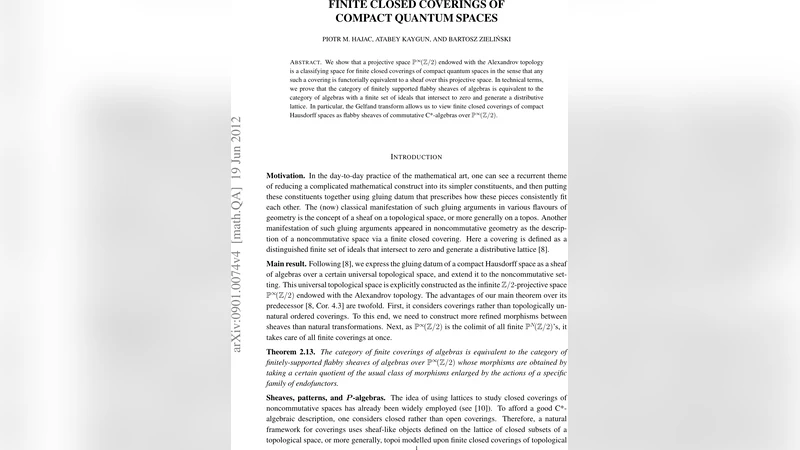
We show that a projective space P^\infty(Z/2) endowed with the Alexandrov topology is a classifying space for finite closed coverings of compact quantum spaces in the sense that any such a covering is functorially equivalent to a sheaf over this projective space. In technical terms, we prove that the category of finitely supported flabby sheaves of algebras is equivalent to the category of algebras with a finite set of ideals that intersect to zero and generate a distributive lattice. In particular, the Gelfand transform allows us to view finite closed coverings of compact Hausdorff spaces as flabby sheaves of commutative C*-algebras over P^\infty(Z/2).
💡 Research Summary
The paper establishes a precise correspondence between finite closed coverings of compact quantum spaces and sheaves of algebras over an infinite‑dimensional projective space equipped with the Alexandrov topology. The authors begin by constructing the projective space (P^{\infty}(\mathbb{Z}/2)) as the set of all infinite binary sequences (elements of the infinite direct sum of (\mathbb{Z}/2)) and endow it with the Alexandrov topology generated by the basic open sets (U_k={x\mid x_k=1}). In this topology every open set is an upward‑closed union of basic opens, which makes the lattice of open subsets naturally distributive.
Next, a compact quantum space is modeled by a unital C(^*)-algebra (A). A finite closed covering of this quantum space is encoded by a finite family of closed two‑sided ideals (I_1,\dots,I_n\subseteq A) satisfying two conditions: (i) the intersection (\bigcap_{k} I_k) is zero (the covering is jointly exhaustive) and (ii) the lattice generated by the (I_k) under sum and intersection is distributive. These algebraic conditions are the non‑commutative analogues of the classical requirements that a family of closed subsets covers a compact Hausdorff space and that the family of closed sets forms a distributive lattice under union and intersection.
From such a data set the authors construct a sheaf (\mathcal{F}) on (P^{\infty}(\mathbb{Z}/2)). For each basic open (U_k) they set (\mathcal{F}(U_k)=A/I_k); for intersections (U_{k_1}\cap\cdots\cap U_{k_m}) they use the canonical quotient maps (A/I_{k_i}\to A/(I_{k_1}+ \cdots + I_{k_m})). Because the Alexandrov topology forces every open set to be a union of finitely many basic opens, the sheaf is uniquely determined by its values on the basic opens. The authors prove that (\mathcal{F}) is flabby (all restriction maps are surjective) and finitely supported (only finitely many basic opens have non‑zero sections). The flabbiness follows from the distributivity of the ideal lattice, which guarantees that the sum of any subfamily of ideals is again an ideal appearing in the lattice.
The central theorem states that the category (\mathbf{Sh}{\mathrm{fin}}(P^{\infty}(\mathbb{Z}/2))) of finitely supported flabby sheaves of algebras is equivalent to the category (\mathbf{Alg}{\mathrm{dist}}) of algebras equipped with a finite family of ideals satisfying the two conditions above. The equivalence is given by two functors:
- (\Phi:\mathbf{Alg}{\mathrm{dist}}\to\mathbf{Sh}{\mathrm{fin}}) sends ((A,{I_k})) to the sheaf (\mathcal{F}) constructed as described.
- (\Psi:\mathbf{Sh}{\mathrm{fin}}\to\mathbf{Alg}{\mathrm{dist}}) takes a sheaf (\mathcal{F}) to its global sections (\mathcal{F}(P^{\infty})); the ideals are recovered as kernels of the restriction maps to the basic opens.
Natural transformations exhibit (\Phi) and (\Psi) as quasi‑inverse equivalences, and morphisms are respected: an inclusion (I_k\subseteq I_\ell) corresponds to the restriction map (\mathcal{F}(U_\ell)\to\mathcal{F}(U_k)). Hence the correspondence works at the level of objects and morphisms, providing a full categorical classification.
When the algebra (A) is commutative, i.e. (A=C(X)) for a compact Hausdorff space (X), the ideals (I_k) are precisely the kernels of restriction maps to closed subsets (K_k\subseteq X). The sheaf (\mathcal{F}) then becomes the familiar flabby sheaf of continuous functions on the closed sets, and the equivalence recovers the classical statement that finite closed coverings of (X) are classified by flabby sheaves of commutative C(^*)-algebras over the projective space (P^{\infty}(\mathbb{Z}/2)). In this way the Gelfand transform bridges the non‑commutative and commutative settings.
The paper concludes by emphasizing that (P^{\infty}(\mathbb{Z}/2)) serves as a universal classifying space for finite closed coverings of compact quantum spaces. The authors suggest several directions for future work: extending the framework to infinite coverings, investigating non‑distributive ideal lattices, and applying the construction to quantum groups and non‑compact quantum spaces. Their results provide a new categorical toolkit for analyzing the internal topology of quantum spaces and open a pathway toward a systematic “covering theory” in non‑commutative geometry.
Comments & Academic Discussion
Loading comments...
Leave a Comment