Non-degenerate colorings in the Brooks Theorem
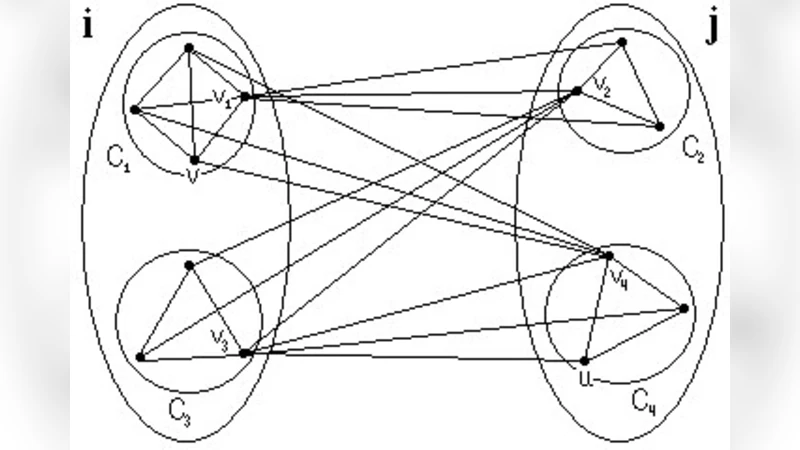
Let $c\geq 2$ and $p\geq c$ be two integers. We will call a proper coloring of the graph $G$ a \textit{$(c,p)$-nondegenerate}, if for any vertex of $G$ with degree at least $p$ there are at least $c$ vertices of different colors adjacent to it. In our work we prove the following result, which generalizes Brook’s Theorem. Let $D\geq 3$ and $G$ be a graph without cliques on $D+1$ vertices and the degree of any vertex in this graph is not greater than $D$. Then for every integer $c\geq 2$ there is a proper $(c,p)$-nondegenerate vertex $D$-coloring of $G$, where $p=(c^3+8c^2+19c+6)(c+1).$ During the primary proof, some interesting corollaries are derived.
💡 Research Summary
The paper introduces a novel strengthening of the classic Brooks theorem by imposing a “non‑degeneracy” requirement on vertex colorings. For integers (c\ge 2) and (p\ge c) a proper coloring of a graph (G) is called ((c,p))-nondegenerate if every vertex whose degree is at least (p) sees at least (c) distinct colors among its neighbours. The main theorem states that if a graph (G) has maximum degree (\Delta(G)=D\ge 3), does not contain a ((D+1))-clique, then for any integer (c\ge 2) there exists a proper coloring with exactly (D) colors that is also ((c,p))-nondegenerate, where
\
Comments & Academic Discussion
Loading comments...
Leave a Comment