On the relation between frequentist and Bayesian approaches for the case of Poisson statistics
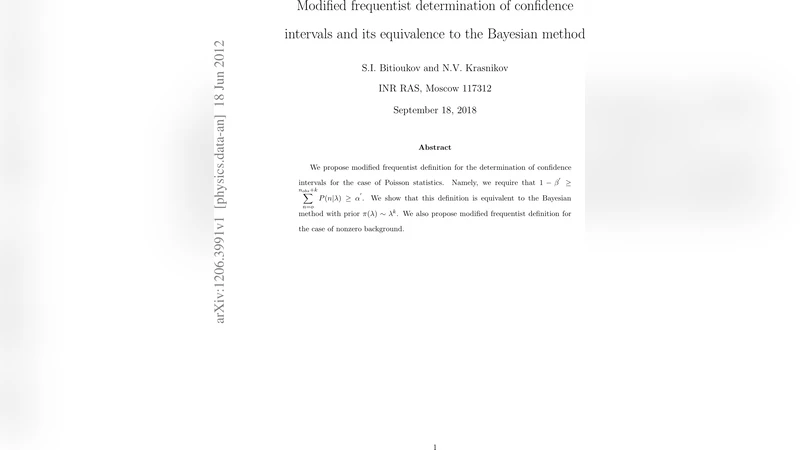
We propose modified frequentist definition for the determination of confidence intervals for the case of Poisson statistics. Namely, we require that 1-\beta’ \geq \sum_{n=o}^{n_{obs}+k} P(n|\lambda) \geq \alpha’. We show that this definition is equivalent to the Bayesian method with prior \pi(\lambda) \sim \lambda^{k}. We also propose modified frequentist definition for the case of nonzero background.
💡 Research Summary
The paper addresses the longstanding question of how frequentist confidence intervals and Bayesian credible intervals relate when the underlying data follow a Poisson distribution. Traditional frequentist constructions for a Poisson mean λ rely on the cumulative probability condition
α ≤ ∑{n=0}^{n{low}} P(n|λ) ≤ 1‑β,
which yields symmetric or one‑sided intervals but can be inflexible, especially when the data are sparse or when a non‑zero background is present.
To overcome these limitations, the authors introduce a “modified frequentist” definition. For any integer k they require that the cumulative probability up to the observed count shifted by k satisfies
1‑β′ ≥ ∑{n=0}^{n{obs}+k} P(n|λ) ≥ α′,
where P(n|λ)=e^{‑λ}λ^{n}/n! is the Poisson probability mass function. The parameter k effectively moves the cutoff point of the cumulative sum: k = 0 reproduces the standard frequentist interval, k > 0 yields a more conservative upper limit, and k < 0 tightens the lower limit. This formulation allows the construction of asymmetric intervals that can be tuned to the experimental context.
The central theoretical result is that this modified frequentist interval is mathematically equivalent to a Bayesian credible interval obtained with a power‑law prior π(λ) ∝ λ^{k}. In the Bayesian framework the posterior is
p(λ|n_{obs}) ∝ π(λ) P(n_{obs}|λ) ∝ λ^{k+n_{obs}} e^{‑λ},
which is a Gamma distribution. Imposing the same tail‑probability conditions (α′ and 1‑β′) on the posterior CDF reproduces exactly the inequality above. Consequently, the choice of k in the frequentist prescription corresponds to the choice of a λ^{k} prior in the Bayesian analysis. When k = 0 the prior is uniform and the two approaches coincide with the classic construction; positive k values give priors that favor larger λ, leading to more conservative upper limits.
The authors extend the methodology to the realistic case where a known background b contributes to the observed count. The total count follows a Poisson distribution with mean s + b, where s is the signal strength of interest. The modified frequentist condition becomes
1‑β′ ≥ ∑{n=0}^{n{obs}+k} P(n|s+b) ≥ α′,
and the corresponding Bayesian prior is π(s) ∝ s^{k}. This treatment keeps the background fixed (as is common in high‑energy physics) while preserving the equivalence between the two statistical philosophies.
Numerical examples illustrate how varying k changes the interval width. For k = 0 the interval matches the standard Feldman‑Cousins or Neyman belt result. Increasing k shifts the upper bound upward, providing a built‑in safeguard against under‑coverage when the background is large. The paper also compares the new construction with the widely used CLs technique, showing that the modified frequentist approach yields comparable or slightly less conservative limits without requiring ad‑hoc adjustments.
In summary, the work offers a unified perspective: by selecting an appropriate power‑law prior (or, equivalently, a suitable integer k), experimenters can move seamlessly between frequentist and Bayesian interpretations of Poisson‑based confidence intervals. This flexibility is especially valuable in particle‑physics searches for rare processes, where the balance between discovery potential and limit robustness must be carefully managed. The proposed framework thus bridges a conceptual gap, providing a practical tool that respects both statistical rigor and experimental pragmatism.
Comments & Academic Discussion
Loading comments...
Leave a Comment