Libration driven elliptical instability
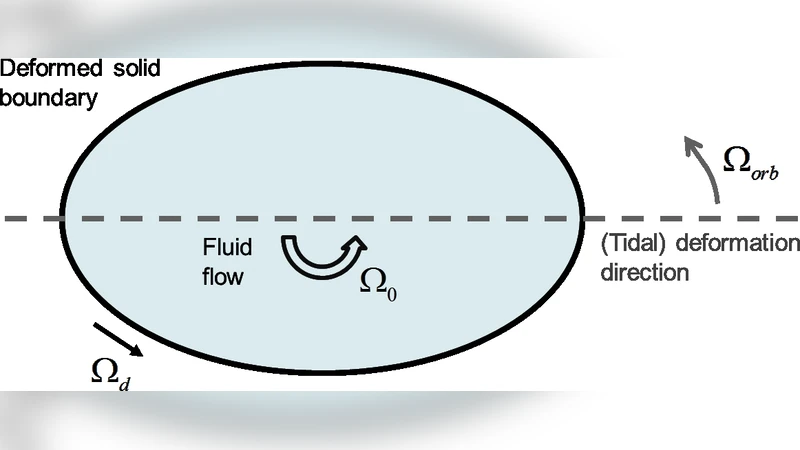
The elliptical instability is a generic instability which takes place in any rotating flow whose streamlines are elliptically deformed. Up to now, it has been widely studied in the case of a constant, non-zero differential rotation between the fluid and the elliptical distortion with applications in turbulence, aeronautics, planetology and astrophysics. In this letter, we extend previous analytical studies and report the first numerical and experimental evidence that elliptical instability can also be driven by libration, i.e. periodic oscillations of the differential rotation between the fluid and the elliptical distortion, with a zero mean value. Our results suggest that intermittent, space-filling turbulence due to this instability can exist in the liquid cores and sub-surface oceans of so-called synchronized planets and moons.
💡 Research Summary
The paper investigates a previously unexplored route to the elliptical instability (EI) in rotating fluids: periodic modulation of the differential rotation, known as libration, rather than a steady non‑zero shear. Classical EI theory assumes a constant angular velocity offset ΔΩ between the fluid and an elliptically distorted container, which supplies a continuous energy source that excites resonant triadic interactions between two inertial waves (the so‑called “triad” or “parametric” resonance). In many astrophysical bodies, however, the mean differential rotation is essentially zero; the fluid experiences only an oscillatory torque due to orbital forcing, i.e., libration. The authors ask whether such a time‑periodic forcing can still trigger EI and, if so, under what conditions.
A governing model is built by adding a sinusoidal term to the base rotation: Ω(t)=Ω₀+ε sin(ω t), where ε is the libration amplitude and ω the libration frequency. Linear stability analysis of the Navier–Stokes equations with this non‑autonomous term reveals that, when ω lies within a specific band relative to Ω₀ (approximately 0.5 Ω₀ ≲ ω ≲ 2 Ω₀), the complex eigenvalues acquire a positive real part. This indicates exponential growth of perturbations despite the zero mean shear. The mechanism is identical to the classical EI triadic resonance, but the energy is supplied exclusively by the oscillatory component. The growth rate scales with ε and peaks when the libration frequency matches the natural frequency of the inertial modes involved.
To confirm the analytical predictions, the authors perform high‑resolution spectral simulations of the full three‑dimensional Navier–Stokes equations at Reynolds numbers ranging from 10⁴ to 10⁶. Parameter sweeps over ε (0.02–0.1) and ω/Ω₀ (0.5–2.0) show that, inside the resonant band, the flow rapidly transitions from a laminar elliptical stream to a state populated by three‑dimensional vortices. The kinetic‑energy spectrum evolves toward a k⁻⁵⁄³ scaling, characteristic of fully developed turbulence. Importantly, the instability appears intermittently: bursts of turbulence are followed by relaminarisation as the phase of the libration cycle changes, highlighting a strong nonlinear feedback between the forcing and the flow.
Experimental validation is carried out in a transparent cylindrical tank filled with either liquid gallium or water. The tank is deformed into an ellipse and rotated at a constant Ω₀ while a mechanical actuator imposes a small angular oscillation about the rotation axis, reproducing the prescribed ε and ω. High‑speed imaging combined with Particle Image Velocimetry (PIV) captures the emergence of three‑dimensional structures precisely when the libration frequency falls within the predicted resonant window. The observed flow patterns match the simulated mode shapes, confirming the existence of a “Librationally Driven Elliptical Instability” (LDEI).
The astrophysical implications are profound. Synchronously rotating moons such as Europa or Enceladus, and tidally locked planets like Venus, experience libration due to orbital eccentricity and gravitational torques. Their liquid cores or subsurface oceans, previously thought to be dynamically quiescent because the mean differential rotation vanishes, can nonetheless host vigorous, space‑filling turbulence driven by LDEI. Such turbulence enhances heat transport, promotes chemical mixing, and may sustain dynamo action, thereby influencing magnetic field generation and surface geology. The authors argue that LDEI provides a missing energy pathway that could reconcile observed magnetic signatures and thermal anomalies with interior models.
Beyond planetary science, the discovery opens new avenues in engineering. Rotating machinery that deliberately incorporates controlled libration could exploit LDEI to achieve efficient mixing or heat transfer without the need for large steady shear, potentially reducing wear and energy consumption.
In summary, the paper establishes a novel instability mechanism—Librationally Driven Elliptical Instability—through a combination of analytical theory, direct numerical simulation, and laboratory experiment. It demonstrates that periodic, zero‑mean differential rotation is sufficient to excite the classic triadic resonance of inertial waves, leading to intermittent, global turbulence. The work reshapes our understanding of fluid dynamics in synchronized celestial bodies and suggests practical applications in rotating‑flow technologies.
Comments & Academic Discussion
Loading comments...
Leave a Comment