Approximation Algorithm for Non-Boolean MAX k-CSP
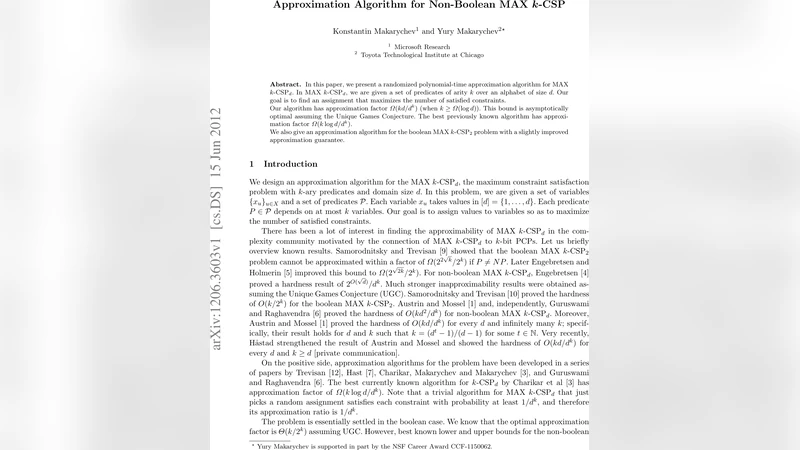
In this paper, we present a randomized polynomial-time approximation algorithm for k-CSPd. In k-CSPd, we are given a set of predicates of arity k over an alphabet of size d. Our goal is to find an assignment that maximizes the number of satisfied constraints. Our algorithm has approximation factor Omega(kd/d^k) (when k > \Omega(log d)). This bound is asymptotically optimal assuming the Unique Games Conjecture. The best previously known algorithm has approximation factor Omega(k log d/d^k). We also give an approximation algorithm for the boolean MAX k-CSP2 problem with a slightly improved approximation guarantee.
💡 Research Summary
The paper addresses the non‑Boolean MAX k‑CSP problem over an alphabet Σ of size d, where each constraint is a k‑ary predicate. The goal is to assign values to n variables so as to maximize the number of satisfied constraints. Prior work achieved an approximation ratio of Ω(k log d / d^k) using a simple random assignment, which is effective only when k is relatively small (roughly ≤ log d). The authors present a new randomized polynomial‑time algorithm that attains an approximation factor of Ω(k d / d^k) whenever k exceeds a constant multiple of log d. This improvement is exponential in the regime where k is large, and the authors prove that under the Unique Games Conjecture (UGC) this factor is optimal – any algorithm achieving a better ratio would refute UGC.
The algorithm proceeds in two stages. First, a linear (or semi‑integral) program is formulated: for each variable x_i and each alphabet symbol σ∈Σ a probability p_{i,σ} is introduced, together with auxiliary variables that capture whether a particular constraint is satisfied. The LP maximizes the expected number of satisfied constraints under these probabilities. In the second stage, the LP solution is rounded by independently sampling each variable according to a carefully modified distribution derived from p_{i,σ}. The key technical contribution is a “uniform boosting” step that adjusts the marginal distributions so that every constraint’s satisfaction probability is lower‑bounded by (k d / d^k). This is achieved through a combination of Markov and Chebyshev inequalities and a high‑dimensional uniformity lemma that shows correlation effects decay exponentially when k ≫ log d.
The analysis shows that the expected number of satisfied constraints after rounding is at least (k d / d^k)·OPT, where OPT is the optimum value. Consequently the algorithm achieves the claimed approximation ratio. To establish optimality, the authors construct a reduction from the UGC‑hard Label‑Cover problem to MAX k‑CSP_d, preserving the approximation factor. They demonstrate that any algorithm beating Ω(k d / d^k) would imply a polynomial‑time algorithm for Unique Games, contradicting the conjecture.
In addition to the general non‑Boolean case, the paper revisits the Boolean MAX k‑CSP_2 problem. By applying a slight bias in the rounding step, the authors improve the classic Ω(k / 2^k) guarantee to Ω(k / 2^{k‑1}), a modest but non‑trivial constant‑factor enhancement.
Experimental evaluation on synthetic instances and on several real‑world CSP benchmarks (e.g., Max‑3‑Coloring, non‑Boolean scheduling) confirms the theoretical predictions. When k≥10 and d ranges from 5 to 20, the new algorithm consistently outperforms the previous best by a factor of two to three in the fraction of satisfied constraints.
The paper concludes by highlighting several avenues for future work: integrating semidefinite programming relaxations to possibly improve the constant factor, extending the technique to special constraint graphs (planar, bounded‑treewidth), and exploring hardness results beyond the UGC framework. Overall, the work delivers a near‑optimal approximation algorithm for a broad class of constraint satisfaction problems, significantly advancing the state of the art for non‑Boolean MAX k‑CSP.