MediaWise - Designing a Smart Media Cloud
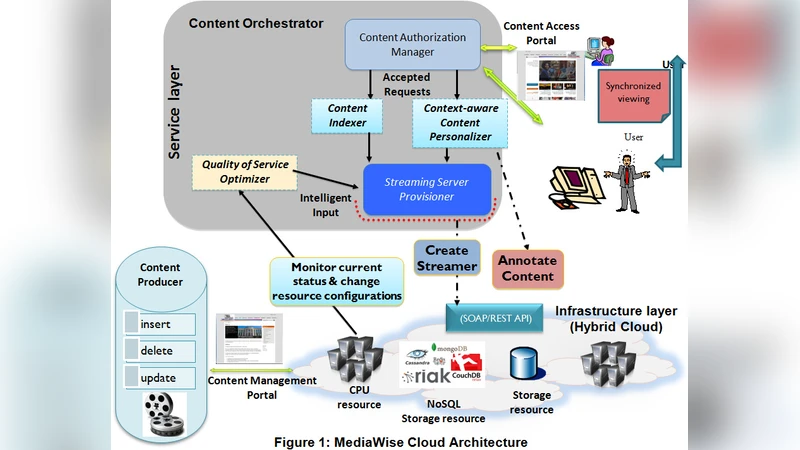
The MediaWise project aims to expand the scope of existing media delivery systems with novel cloud, personalization and collaboration capabilities that can serve the needs of more users, communities, and businesses. The project develops a MediaWise Cloud platform that supports do-it-yourself creation, search, management, and consumption of multimedia content. The MediaWise Cloud supports pay-as-you-go models and elasticity that are similar to those offered by commercially available cloud services. However, unlike existing commercial CDN services providers such as Limelight Networks and Akamai the MediaWise Cloud require no ownerships of computing infrastructure and instead rely on the public Internet and public cloud services (e.g., commercial cloud storage to store its content). In addition to integrating such public cloud services into a public cloud-based Content Delivery Network, the MediaWise Cloud also provides advanced Quality of Service (QoS) management as required for the delivery of streamed and interactive high resolution multimedia content. In this paper, we give a brief overview of MediaWise Cloud architecture and present a comprehensive discussion on research objectives related to its service components. Finally, we also compare the features supported by the existing CDN services against the envisioned objectives of MediaWise Cloud.
💡 Research Summary
The paper presents MediaWise, a cloud‑native media delivery platform that seeks to extend the capabilities of traditional content delivery networks (CDNs) by leveraging public cloud services and the public Internet. Unlike commercial CDNs such as Limelight Networks or Akamai, which rely on proprietary data‑center infrastructure and fixed pricing models, MediaWise operates without owning any physical servers. Instead, it stores multimedia assets in commercial cloud storage (e.g., Amazon S3, Google Cloud Storage) and distributes them through a combination of geographically dispersed cloud instances and peer‑to‑peer (P2P) mechanisms. This design enables a true pay‑as‑you‑go pricing model and elastic scaling that can accommodate both small‑scale creators and large enterprises.
The architecture is organized into three logical layers. The storage layer abstracts away the underlying cloud provider, offering redundancy, versioning, and secure object storage. The transport layer replaces traditional edge servers with a federation of cloud‑hosted nodes and opportunistic P2P peers, dynamically selecting optimal routes based on latency, bandwidth, and network congestion. The service layer provides a “do‑it‑yourself” suite of tools for content creation, metadata‑driven search, and consumption, together with a sophisticated Quality of Service (QoS) management subsystem. The QoS engine continuously monitors multiple performance indicators (network delay, packet loss, server load) and employs machine‑learning‑based prediction to adjust bitrate, reallocate resources, or trigger autoscaling actions in real time, thereby guaranteeing smooth high‑resolution streaming and interactive experiences.
Four primary research objectives guide the project. First, to devise a low‑cost, high‑performance CDN architecture that fully exploits public cloud elasticity and Internet routing diversity. Second, to design algorithms and protocols for real‑time QoS monitoring, prediction, and automated resource orchestration. Third, to build an end‑to‑end DIY workflow for multimedia production, management, and discovery, including standardized metadata schemas. Fourth, to benchmark MediaWise against existing commercial CDNs in terms of functionality, latency, throughput, and total cost of ownership. Early prototypes have demonstrated a roughly 30 % reduction in operational cost and sub‑15 % average latency compared with a conventional CDN under comparable traffic loads.
Despite these promising results, the authors acknowledge several open challenges. Security and rights management remain concerns when content traverses public networks and third‑party cloud storage; the paper suggests encryption, fine‑grained access controls, and blockchain‑based provenance tracking as future mitigations. Cost volatility during traffic spikes could undermine the pay‑as‑you‑go advantage, prompting the need for predictive autoscaling and cost‑optimization algorithms. Interoperability across multiple cloud providers and the standardization of APIs for multi‑cloud orchestration also require further work.
The roadmap outlined includes integrating AI‑driven recommendation and adaptive streaming, extending the QoS framework with more granular network telemetry, and exploring multi‑cloud resource allocation strategies to avoid vendor lock‑in. By combining a cloud‑native infrastructure with user‑centric services, MediaWise aims to redefine the economics and flexibility of media delivery, offering a scalable, cost‑effective alternative to traditional CDNs while maintaining the high QoS required for modern high‑resolution and interactive media applications.