Quantales of open groupoids
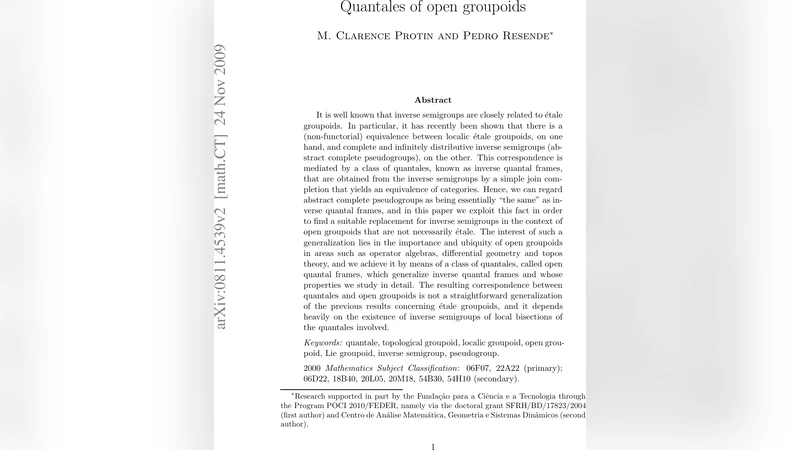
It is well known that inverse semigroups are closely related to 'etale groupoids. In particular, it has recently been shown that there is a (non-functorial) equivalence between localic 'etale groupoids, on one hand, and complete and infinitely distributive inverse semigroups (abstract complete pseudogroups), on the other. This correspondence is mediated by a class of quantales, known as inverse quantal frames, that are obtained from the inverse semigroups by a simple join completion that yields an equivalence of categories. Hence, we can regard abstract complete pseudogroups as being essentially ``the same’’ as inverse quantal frames, and in this paper we exploit this fact in order to find a suitable replacement for inverse semigroups in the context of open groupoids that are not necessarily 'etale. The interest of such a generalization lies in the importance and ubiquity of open groupoids in areas such as operator algebras, differential geometry and topos theory, and we achieve it by means of a class of quantales, called open quantal frames, which generalize inverse quantal frames and whose properties we study in detail. The resulting correspondence between quantales and open groupoids is not a straightforward generalization of the previous results concerning 'etale groupoids, and it depends heavily on the existence of inverse semigroups of local bisections of the quantales involved.
💡 Research Summary
The paper builds a bridge between the algebraic world of quantales and the geometric world of open groupoids, extending the well‑known correspondence between étale groupoids and inverse semigroups. In the étale setting, complete infinitely distributive inverse semigroups (abstract complete pseudogroups) are equivalent, via a non‑functorial construction, to inverse quantal frames—frames obtained by a simple join‑completion of the semigroup. The authors ask whether a similar algebraic object can capture the richer class of open groupoids, which are not required to be étale but appear ubiquitously in operator algebras, differential geometry, and topos theory.
To answer this, they introduce open quantal frames, a class of quantales that generalises inverse quantal frames by imposing an “openness” condition on the multiplication. Concretely, an open quantal frame (Q) is a complete lattice equipped with a binary multiplication that (i) distributes over arbitrary joins, (ii) is associative, and (iii) for each element (a\in Q) the map (a\wedge - : Q\to Q) is an open map in the locale sense. This extra openness mirrors the requirement that the structure maps of an open groupoid be open continuous maps.
The central construction starts from an arbitrary open groupoid (\mathcal{G}). Its local bisections—subsets that intersect each source and target fibre in at most one point—form a set (B(\mathcal{G})). Equipped with pointwise multiplication and join, (B(\mathcal{G})) becomes an inverse semigroup (S(\mathcal{G})). Unlike the étale case, the multiplication in (S(\mathcal{G})) respects the openness of the groupoid’s source and target maps. The authors then take the join‑completion of (S(\mathcal{G})), denoted (Q(S(\mathcal{G}))). They prove that (Q(S(\mathcal{G}))) satisfies the three axioms of an open quantal frame, thereby providing a canonical quantale associated to any open groupoid.
Conversely, given an open quantal frame (Q), one can recover a locale‑theoretic groupoid (\operatorname{Spec}(Q)) by considering its spectrum of prime elements equipped with the natural source, target, and multiplication maps induced by the quantale structure. The paper shows that the two constructions are adjoint: the “spectrum” functor (\operatorname{Spec}: \mathbf{OpenQuantFrames}\to\mathbf{OpenGroupoids}) is left adjoint to the “bisection‑completion” functor (\mathcal{G}\mapsto Q(S(\mathcal{G}))). Under the completeness and infinite distributivity hypotheses, this adjunction becomes an equivalence of categories, mirroring the étale case but now valid for the broader class of open groupoids.
Beyond the categorical equivalence, the authors investigate intrinsic algebraic properties of open quantal frames. They establish the existence of internal automorphisms, describe how sub‑frames closed under the multiplication interact with joins, and prove a version of the Frobenius reciprocity law adapted to the open setting. These results reveal that open quantal frames retain much of the rich structure of inverse quantal frames while accommodating the additional topological flexibility required by open groupoids.
The paper concludes with concrete examples. First, it treats the open groupoid arising from a topos of sheaves on a locale, showing how the associated quantale recovers the well‑known locale of opens. Second, it examines the holonomy groupoid of a foliated manifold, which is typically non‑étale but open; the construction yields a quantale that encodes the leafwise topology and holonomy data. These examples illustrate that the theory is not merely an abstract generalisation but provides practical tools for analysing groupoids that appear in analysis, geometry, and logic.
In summary, the authors have identified the correct algebraic counterpart—open quantal frames—for open groupoids, proved a categorical equivalence mediated by local bisections, and explored the resulting algebraic landscape. This work opens avenues for further research, including cohomology theories for open quantal frames, representation theory in non‑commutative geometry, and applications to the study of C(^*)-algebras associated with non‑étale groupoids.
Comments & Academic Discussion
Loading comments...
Leave a Comment