The Computational Complexity of Sensitivity Analysis and Parameter Tuning
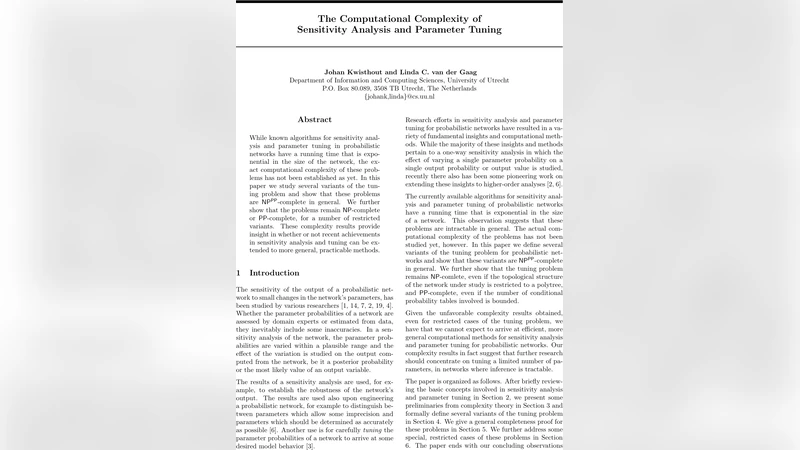
While known algorithms for sensitivity analysis and parameter tuning in probabilistic networks have a running time that is exponential in the size of the network, the exact computational complexity of these problems has not been established as yet. In this paper we study several variants of the tuning problem and show that these problems are NPPP-complete in general. We further show that the problems remain NP-complete or PP-complete, for a number of restricted variants. These complexity results provide insight in whether or not recent achievements in sensitivity analysis and tuning can be extended to more general, practicable methods.
💡 Research Summary
The paper investigates the fundamental computational difficulty of two closely related tasks in probabilistic graphical models—sensitivity analysis and parameter tuning—particularly within Bayesian networks. Although practitioners have long known that exact algorithms for these tasks exhibit exponential running times, the precise complexity class to which they belong had not been formally identified. The authors fill this gap by mapping the decision versions of the problems onto well‑studied complexity classes and by providing a series of reductions that establish hardness results under various assumptions.
The central contribution is a proof that the general parameter‑tuning problem is NPPP‑complete. To achieve this, the authors construct a polynomial‑time reduction from an NPPP‑complete problem (existential quantification over a PP oracle) to the tuning task. They encode a Boolean circuit as a Bayesian network, associate each network parameter with a Boolean variable, and define a target posterior probability threshold. The question “does there exist a setting of the parameters such that the posterior exceeds the threshold?” is shown to be equivalent to “∃ parameter assignment : PP‑oracle answers YES,” which matches the definition of NPPP. Consequently, any algorithm that solves the tuning problem exactly would also solve any problem in NPPP, implying that a polynomial‑time exact solution is unlikely unless the polynomial hierarchy collapses.
Beyond the general case, the paper explores several restricted variants and demonstrates that the complexity drops to more familiar classes when structural or quantitative constraints are imposed:
-
Tree‑structured networks or single‑variable influence – When the network topology is a tree or each parameter influences only one variable, the tuning problem becomes NP‑complete. The reduction from SAT shows that finding a feasible parameter assignment is as hard as Boolean satisfiability, but verification remains polynomial, placing the problem squarely in NP.
-
Extreme probability thresholds – If the desired posterior is required to be very close to 0 or 1 (rather than a moderate value such as 0.5), the decision problem aligns with PP‑complete problems. The authors reduce from MAJORITY‑SAT, illustrating that determining whether a majority of assignments satisfy a formula corresponds to checking whether the posterior exceeds an extreme threshold.
-
Discrete or bounded parameter domains – Even when parameters are restricted to a finite set of values, the problem does not become easier; it remains NP‑complete or PP‑complete depending on the exact formulation of the threshold condition.
These results collectively map out a detailed landscape: the full‑blown tuning problem sits at the top of the hierarchy (NPPP), while natural restrictions push it down to NP or PP. The authors also discuss the practical implications of these findings. Since NPPP‑completeness rules out polynomial‑time exact algorithms for general networks (unless major complexity‑theoretic breakthroughs occur), practitioners must rely on approximation schemes, sampling‑based estimators, or algorithms that exploit special structure (e.g., treewidth‑bounded networks). The paper briefly outlines existing polynomial‑time methods for tree‑structured networks and highlights how they fit within the NP‑complete regime identified.
In the concluding section, the authors acknowledge that while they have established tight worst‑case bounds, there remains a substantial gap between these theoretical limits and the performance of heuristic or approximate methods used in real‑world applications. They suggest several avenues for future work: developing provably good approximation algorithms, investigating parameter‑space exploration via meta‑heuristics or reinforcement learning, and extending the complexity analysis to dynamic or hybrid models (e.g., influence diagrams). By delivering the first comprehensive classification of sensitivity analysis and parameter tuning in probabilistic networks, the paper provides both a theoretical foundation and a roadmap for algorithm designers seeking to balance exactness, efficiency, and applicability.