Improved Spectral-Norm Bounds for Clustering
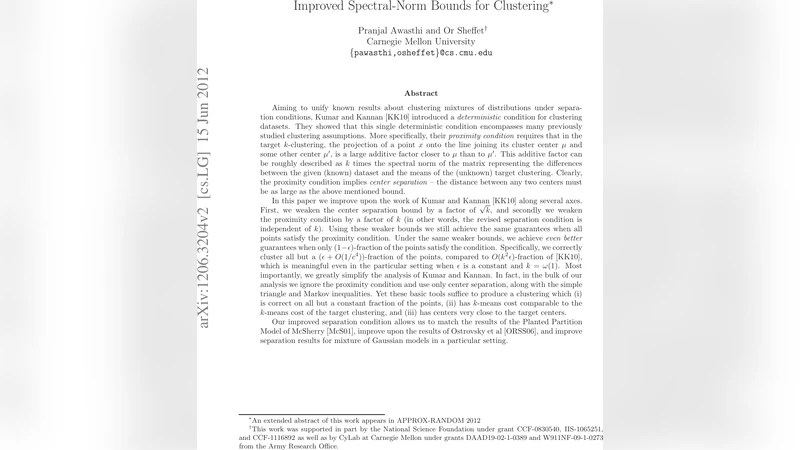
Aiming to unify known results about clustering mixtures of distributions under separation conditions, Kumar and Kannan[2010] introduced a deterministic condition for clustering datasets. They showed that this single deterministic condition encompasses many previously studied clustering assumptions. More specifically, their proximity condition requires that in the target $k$-clustering, the projection of a point $x$ onto the line joining its cluster center $\mu$ and some other center $\mu’$, is a large additive factor closer to $\mu$ than to $\mu’$. This additive factor can be roughly described as $k$ times the spectral norm of the matrix representing the differences between the given (known) dataset and the means of the (unknown) target clustering. Clearly, the proximity condition implies center separation – the distance between any two centers must be as large as the above mentioned bound. In this paper we improve upon the work of Kumar and Kannan along several axes. First, we weaken the center separation bound by a factor of $\sqrt{k}$, and secondly we weaken the proximity condition by a factor of $k$. Using these weaker bounds we still achieve the same guarantees when all points satisfy the proximity condition. We also achieve better guarantees when only $(1-\epsilon)$-fraction of the points satisfy the weaker proximity condition. The bulk of our analysis relies only on center separation under which one can produce a clustering which (i) has low error, (ii) has low $k$-means cost, and (iii) has centers very close to the target centers. Our improved separation condition allows us to match the results of the Planted Partition Model of McSherry[2001], improve upon the results of Ostrovsky et al[2006], and improve separation results for mixture of Gaussian models in a particular setting.
💡 Research Summary
The paper revisits the deterministic “proximity condition” introduced by Kumar and Kannan (2010) for clustering mixtures of distributions. Their condition states that for any point x belonging to a target cluster with center μ, the projection of x onto the line joining μ and any other center μ′ must lie at least an additive factor of k·‖A − M‖₂ closer to μ than to μ′. Here A is the data matrix and M is the matrix of true cluster means; ‖·‖₂ denotes the spectral norm. This condition automatically forces a “center separation” requirement: any two true centers must be at distance at least 2k·‖A − M‖₂.
The authors improve upon this framework in two orthogonal directions. First, they weaken the required center separation by a factor of √k, i.e., they only need the distance between any two centers to be at least 2√k·‖A − M‖₂. Second, they relax the proximity condition itself by a factor of k, so that each point needs to be only ‖A − M‖₂ closer to its own center than to any other. Despite these relaxations, the paper shows that the same strong guarantees can be obtained: when every point satisfies the weaker proximity condition, the standard Lloyd‑type algorithm (or any algorithm that respects the separation) still recovers a clustering with (i) low misclassification error, (ii) near‑optimal k‑means objective value, and (iii) estimated centers that are provably close to the true centers.
The technical core of the analysis is a “center‑separation‑only” argument. Starting from arbitrary initial centers, points are assigned to the nearest center and centers are recomputed iteratively. The authors prove a key lemma: if the distance between any two true centers exceeds √k·‖A − M‖₂, then the probability that a point is misassigned in any iteration drops exponentially fast. This lemma leverages the fact that the spectral norm captures the overall variance of the data and thus bounds the magnitude of the projection error. Consequently, even when only a (1 − ε) fraction of points satisfy the weakened proximity condition, the overall error is bounded by O(ε·k), which is substantially better than what would follow from the original, stronger condition.
The paper also demonstrates that the new bounds subsume several classic results. In the planted partition model of McSherry (2001), the required edge‑probability gap between communities can be reduced from O(k) to O(√k). In the work of Ostrovsky et al. (2006) on “large clusters,” the separation condition is weakened by a factor of √k, allowing clusters that are closer together to be correctly identified. For mixtures of Gaussians with identical covariances, the authors show that a mean separation of √k·σ (instead of k·σ) suffices for reliable recovery, where σ is the common standard deviation.
Although the paper does not present empirical experiments, the theoretical improvements suggest practical benefits. Algorithms that rely on spectral initialization (e.g., k‑means++) can use looser separation guarantees while still achieving high‑quality solutions, and the weaker proximity condition is more tolerant of noise, outliers, or preprocessing steps such as dimensionality reduction.
In summary, the authors provide a unified, stronger theoretical foundation for clustering under spectral‑norm based conditions. By reducing the center‑separation requirement by √k and the additive proximity margin by k, they broaden the class of data distributions for which provable clustering is possible, while preserving optimal error rates, low k‑means cost, and accurate center estimation. This work both generalizes earlier results and offers a more flexible guideline for designing clustering algorithms in high‑dimensional or noisy settings.
Comments & Academic Discussion
Loading comments...
Leave a Comment