A Pedagogical "Toy" Climate Model
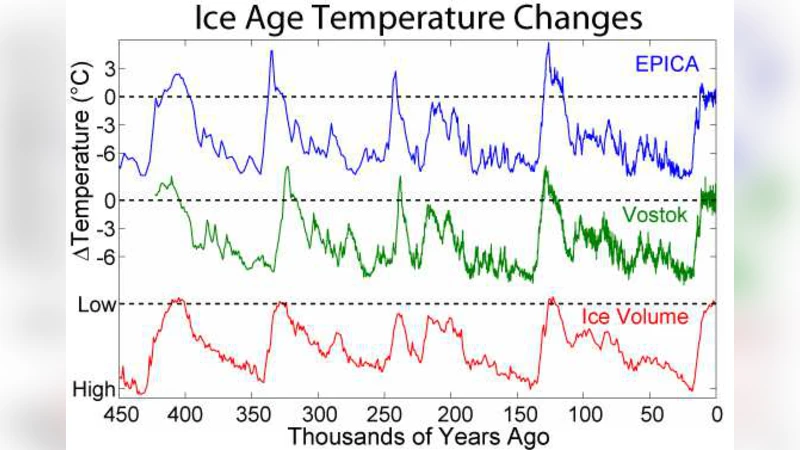
A “toy” model, simple and elementary enough for an undergraduate class, of the temperature dependence of the greenhouse (mid-IR) absorption by atmospheric water vapor implies a bistable climate system. The stable states are glaciation and warm interglacials, while intermediate states are unstable. This is in qualitative accord with the paleoclimatic data. The present climate may be unstable, with or without anthropogenic interventions such as CO$_2$ emission, unless there is additional stabilizing feedback such as “geoengineering”.
💡 Research Summary
The paper presents a highly simplified, pedagogical “toy” model that captures the essential nonlinear feedback between atmospheric water‑vapor infrared absorption and surface temperature. Starting from the well‑known Clausius‑Clapeyron relation, the author approximates the water‑vapor absorption coefficient α(T) as a sigmoidal function of temperature: near zero at low temperatures, rising sharply around a characteristic temperature T₀, and approaching unity at high temperatures. This functional form is inserted into a two‑layer radiative‑energy‑balance framework that treats the surface and the well‑mixed troposphere as single temperature reservoirs (Tₛ and Tₐ). Solar insolation S is held constant, while outgoing long‑wave radiation follows the Stefan‑Boltzmann law (σT⁴). The model equations therefore read, in essence, that the net radiative flux at the surface equals the absorbed solar flux minus the infrared flux emitted upward, plus the fraction α(Tₐ) of the atmospheric back‑radiation that is re‑absorbed. Because α(Tₐ) depends steeply on temperature, the coupled equations become highly nonlinear and admit multiple steady‑state solutions.
A fixed‑point analysis reveals three equilibria: two stable nodes (a cold, glaciated state and a warm, interglacial state) and one intermediate unstable node. The cold branch corresponds to a regime where water vapor is scarce, the atmosphere is largely transparent in the mid‑IR, and radiative cooling dominates, keeping the planet frozen. The warm branch reflects a regime where water vapor is abundant, the atmosphere becomes opaque, and the positive water‑vapor feedback amplifies warming, stabilizing a relatively high‑temperature climate. The middle equilibrium has a positive slope in the temperature‑flux diagram, meaning any perturbation drives the system away toward one of the two stable branches. This bistability reproduces the qualitative pattern observed in paleoclimate records, where Earth has switched relatively abruptly between glacial and interglacial periods.
Crucially, the model suggests that the present climate may sit near the unstable branch. In such a configuration, even modest external forcings—whether anthropogenic CO₂ emissions or natural variations—could tip the system into either a warmer or a cooler stable state. The analysis therefore challenges the notion that climate change is a smooth, linear response to greenhouse‑gas concentrations; instead, it highlights the possibility of threshold behavior and rapid transitions inherent to the water‑vapor feedback alone.
Because the toy model deliberately omits many real‑world processes (cloud dynamics, ocean heat transport, ice‑albedo feedbacks, etc.), the author emphasizes its role as a conceptual tool rather than a predictive climate model. Nonetheless, the simplicity makes the core physics transparent for undergraduate instruction and underscores the importance of additional stabilizing mechanisms. The paper concludes by proposing that, if the climate is indeed perched on an unstable ridge, deliberate geoengineering interventions—such as stratospheric aerosol injection to increase planetary albedo—might be required to provide a negative feedback that keeps the system within a desirable temperature window.
Overall, the study offers a clear, analytically tractable illustration of how a single nonlinear feedback can generate multiple climate equilibria, why intermediate states are inherently unstable, and what implications this has for interpreting past climate shifts and for anticipating future climate trajectories under both natural and anthropogenic influences.
Comments & Academic Discussion
Loading comments...
Leave a Comment