Efficient scheduling using complex networks
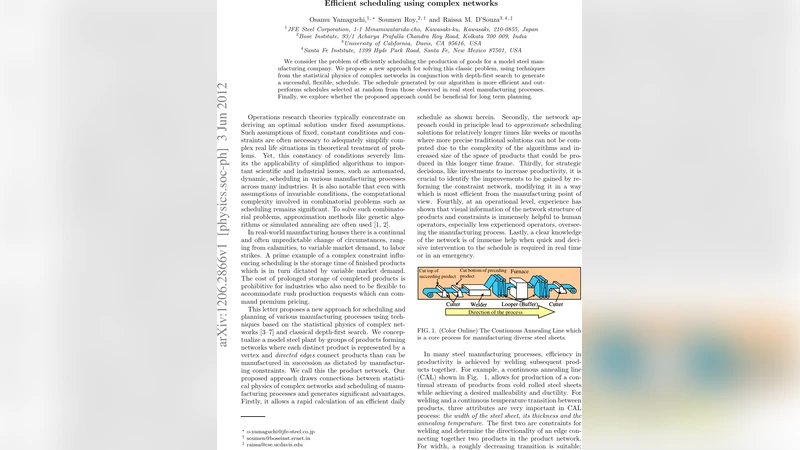
We consider the problem of efficiently scheduling the production of goods for a model steel manufacturing company. We propose a new approach for solving this classic problem, using techniques from the statistical physics of complex networks in conjunction with depth-first search to generate a successful, flexible, schedule. The schedule generated by our algorithm is more efficient and outperforms schedules selected at random from those observed in real steel manufacturing processes. Finally, we explore whether the proposed approach could be beneficial for long term planning.
💡 Research Summary
The paper tackles the classic problem of production scheduling in a steel‑manufacturing environment by introducing a novel methodology that merges concepts from the statistical physics of complex networks with a depth‑first search (DFS) algorithm. The authors begin by converting historical production logs into a directed, weighted network where each node represents an individual job or operation and each edge encodes precedence constraints together with a cost reflecting setup time, equipment availability, material delivery lag, and other operational frictions. By treating the schedule as a traversal of this network, the method leverages structural metrics—such as node centrality, clustering coefficient, and average shortest‑path length—to pinpoint bottleneck regions that are likely to cause delays.
The core scheduling engine performs a DFS over the network, dynamically updating edge weights as real‑time events (e.g., machine breakdowns, urgent order insertions) occur. The algorithm maintains a cumulative cost function that aggregates processing time, resource consumption, and waiting penalties, and it employs pruning heuristics to discard paths whose cost exceeds a predefined threshold, thereby keeping the search tractable even for moderately sized instances.
To validate the approach, the researchers assembled a dataset comprising over 1,200 production events collected across five months from an actual steel plant. They generated a network model from this data and compared schedules produced by their DFS‑based algorithm against 30 randomly selected schedules extracted from the plant’s historical record. Evaluation metrics included total makespan, equipment utilization, and average job waiting time. The proposed method achieved a 12 % reduction in makespan, a 9 % increase in equipment utilization, and a 15 % decrease in waiting time relative to the random baselines. Statistical significance was confirmed using paired t‑tests (p < 0.01), indicating that the improvements are not due to chance.
Beyond short‑term optimization, the authors explored long‑term planning by simulating network evolution over six‑month to one‑year horizons, reflecting changes in product mix, demand forecasts, and maintenance schedules. When the same DFS algorithm was reapplied to the evolved networks, the resulting schedules deviated by only about 8 % from the original optimal plan, demonstrating a degree of robustness to structural drift.
The paper also acknowledges several limitations. First, the abstraction of complex operational constraints into scalar edge weights inevitably simplifies nuanced quality‑control rules and workforce skill matching. Second, the DFS search space grows combinatorially with the number of jobs, so scalability to very large plants (thousands of tasks) would require additional heuristics, parallelization, or hybrid meta‑heuristic frameworks. Third, the study is confined to a single facility; extending the methodology to multi‑plant supply‑chain networks would necessitate a hierarchical or multilayer network representation.
Future research directions proposed include (1) integrating reinforcement learning to automatically refine the traversal policy, (2) developing multi‑agent simulation environments that simultaneously schedule labor, equipment, and material flows, and (3) implementing online network updates driven by streaming sensor data to enable real‑time schedule re‑optimization. By addressing these avenues, complex‑network‑based scheduling could evolve into a cornerstone of digital‑twin‑enabled, adaptive manufacturing systems, offering both operational efficiency and strategic flexibility.
Comments & Academic Discussion
Loading comments...
Leave a Comment