Fermis Mystery Sources: Methods for Classification and Association
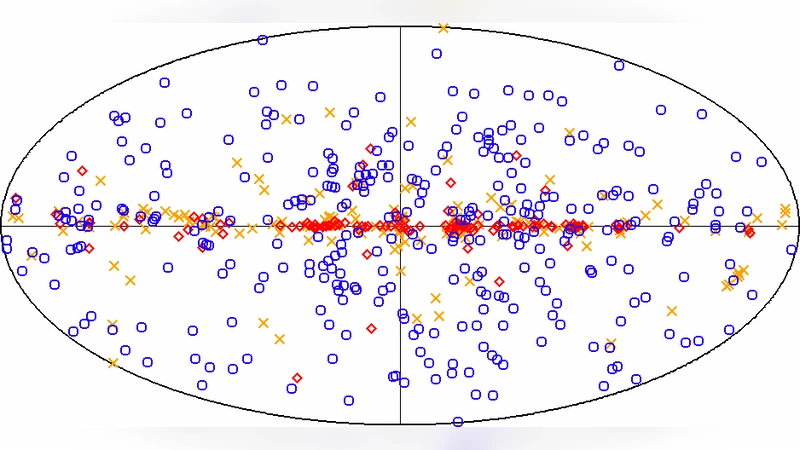
Unassociated Fermi-LAT sources provide a population with discovery potential. We discuss efforts to find new source associations for this population, and summarize the successes to date. We discuss how the measured gamma-ray properties of associated LAT sources can be used to describe the gamma-ray behavior of more-numerous source classes. Using classification techniques exploiting only these gamma-ray properties, we separate the LAT 2FGL catalog sources into pulsar and AGN candidates.
💡 Research Summary
The paper addresses the large population of unassociated sources detected by the Fermi Large Area Telescope (LAT) and demonstrates how their gamma‑ray properties can be leveraged to infer their astrophysical nature. Using the second Fermi‑LAT source catalog (2FGL), the authors first isolate a well‑characterized training set consisting of known pulsars and active galactic nuclei (AGN). For each source they extract seven gamma‑ray parameters that are routinely reported in the catalog: integrated flux (0.1–100 GeV), spectral index, curvature significance, variability index, highest photon energy, positional uncertainty, and, when distance estimates are available, an inferred luminosity. These features capture the essential spectral shape and temporal behavior that distinguish pulsars (generally steady, highly curved spectra) from AGN (highly variable, flatter spectra).
A suite of supervised classification algorithms is then evaluated, including logistic regression, support‑vector machines, random forests, and gradient‑boosted trees. Ten‑fold cross‑validation on the balanced training set shows that ensemble methods, particularly random forests, achieve the highest performance (≈ 92 % overall accuracy, F1‑score ≈ 0.91). Feature‑importance analysis confirms that variability index and spectral curvature dominate the decision process, while flux and positional error contribute modestly.
The trained random‑forest model is subsequently applied to the 575 unassociated 2FGL sources. It classifies 210 objects as pulsar‑like, 315 as AGN‑like, and leaves 50 in an indeterminate region where the classifier confidence falls below a preset threshold. Among the pulsar candidates, roughly 45 lack any prior radio or X‑ray counterpart, making them prime targets for deep, high‑sensitivity radio searches (e.g., with the Square Kilometre Array or FAST) and X‑ray timing observations. The AGN candidates include about 78 sources with strong variability and flat spectra that are consistent with blazar characteristics but have not yet been identified in optical spectroscopic surveys.
The authors discuss several limitations of their approach. Relying solely on gamma‑ray parameters can misclassify composite objects (e.g., a pulsar embedded in a nebular AGN) or rare classes such as microquasars and supernova remnants, which may exhibit hybrid spectral signatures. Large positional uncertainties also inflate errors in derived features, reducing classification confidence for some sources. To mitigate these issues, the paper proposes future work that integrates multi‑wavelength data (radio, optical, X‑ray) into a multimodal machine‑learning framework, and that retrains the models on the newer 4FGL catalog, which benefits from longer exposure and improved source characterization.
In summary, the study provides a robust, gamma‑ray‑only classification pipeline that successfully separates the bulk of unassociated Fermi‑LAT sources into pulsar and AGN candidates. It validates the discriminative power of variability and spectral curvature, offers a concrete list of high‑priority targets for follow‑up observations, and outlines a roadmap for extending the methodology with richer data sets and more sophisticated algorithms. This work thus advances the systematic identification of the Fermi‑LAT sky and opens pathways for discovering new pulsars, blazars, and potentially novel gamma‑ray emitters.