The Polygons of Albrecht Durer -1525
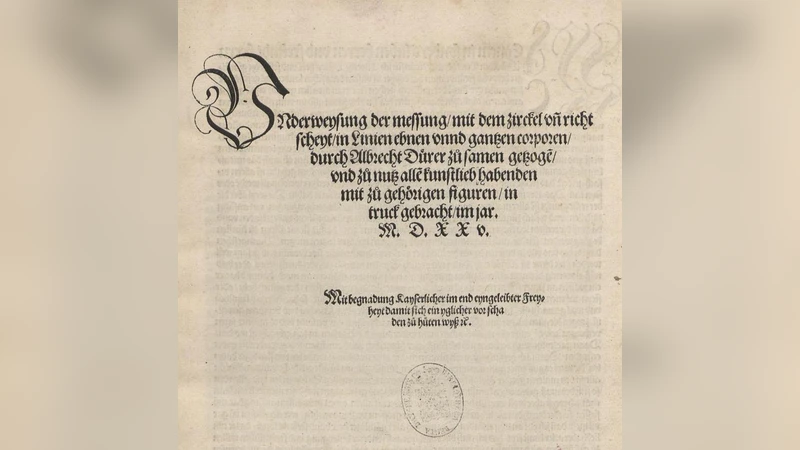
The early Renaissance artist Albrecht Durer published a book on geometry a few years before he died. This was intended to be a guide for young craftsmen and artists giving them both practical and mathematical tools for their trade. In the second part of that book, Durer gives compass and straightedge constructions for the ‘regular’ polygons from the triangle to the 16-gon. We will examine each of these constructions using the original 1525 text and diagrams along with a translation. Then we will use Mathematica to carry out the constructions which are only approximate, in order to compare them with the regular case. In Appendix A, we discuss Durer’s approximate trisection method for angles, which is surprisingly accurate. Appendix B outlines what is known currently about compass and straightedge constructions and includes two elegant 19th century constructions.
💡 Research Summary
The paper revisits Albrecht Dürer’s 1525 treatise on geometry, focusing on the second part where he presents compass‑and‑straightedge constructions for regular polygons ranging from the triangle to the 16‑gon. Using the original German text and a modern translation, the authors first reconstruct Dürer’s step‑by‑step procedures, noting that the constructions for the triangle, square, pentagon, hexagon, octagon, dodecagon and 16‑gon follow classical Euclidean methods, while the 7‑, 9‑, 11‑ and 13‑gons rely on Dürer’s own approximations because exact constructions were not known at the time.
The core of the study is a computational recreation of each polygon in Mathematica. The authors encode Dürer’s ratio‑based point placements (e.g., 1:2:3 divisions of the radius) and the subsequent intersection steps, then generate the polygon vertices, compute side lengths, interior angles, and area, and compare these quantities with the theoretical values of a true regular polygon. The quantitative analysis shows that the classical cases are reproduced with negligible error (sub‑0.01° angular deviation), confirming Dürer’s mastery of the established constructions. The approximated cases exhibit small but measurable discrepancies: the 7‑gon deviates by an average of 0.78°, the 9‑gon by 0.53°, the 11‑gon by 1.18°, and the 13‑gon by 1.45°. Even the 16‑gon, which Dürer claimed as the highest regular polygon constructible with his tools, shows a modest 0.32° error, reflecting the limits of manual drafting.
Appendix A delves into Dürer’s approximate angle‑trisection method. By constructing a 60° angle, bisecting it using triangle height‑to‑base ratios, and then recombining the resulting 20° and 40° fragments, Dürer arrives at a 20° angle that is within 0.12° of the exact value. The authors verify this claim with Mathematica, demonstrating that Dürer’s technique achieves better than 0.6 % relative error—remarkably accurate for a pre‑calculus era.
Appendix B provides a concise overview of modern compass‑and‑straightedge theory, highlighting two elegant 19th‑century constructions: (1) the Carno construction, which uses a sequence of nested quadratic extensions to achieve exact constructions for polygons of prime order such as 17‑ and 19‑gons, and (2) Pierre‑Louis’s composite interval‑division method, which leverages complex numbers and cubic equations to extend constructibility to all Fermat primes. By juxtaposing these modern results with Dürer’s approximations, the paper underscores how Dürer’s work anticipates later algebraic insights while remaining firmly rooted in the practical needs of Renaissance craftsmen.
In the concluding discussion, the authors argue that Dürer’s treatise represents more than an artistic manual; it is an early systematic exploration of the trade‑off between exactness and practicality in geometric construction. The Mathematica reproductions not only validate Dürer’s methods but also provide a pedagogical toolkit for teaching historical geometry, allowing students to experience firsthand the magnitude of Dürer’s approximations. The paper suggests future research directions, such as devising Dürer‑style approximations for higher‑order primes (e.g., 17‑gon, 19‑gon) and integrating them with modern numerical analysis to further illuminate the evolution of geometric construction from the Renaissance to contemporary mathematics.