The Complexity of Monotone Hybrid Logics over Linear Frames and the Natural Numbers
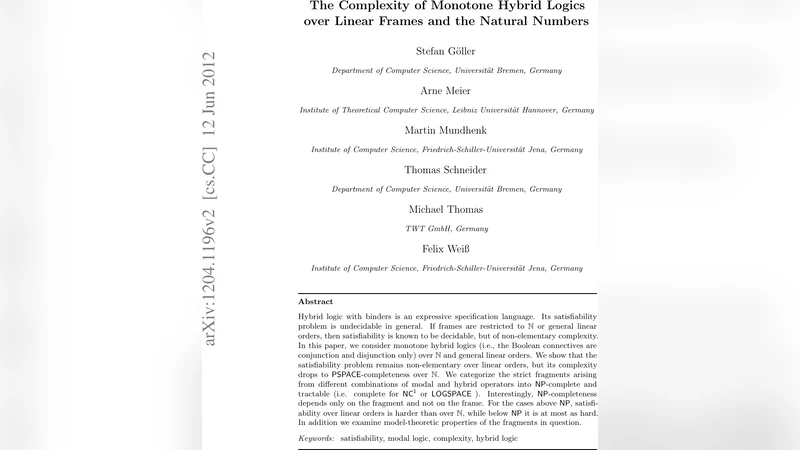
Hybrid logic with binders is an expressive specification language. Its satisfiability problem is undecidable in general. If frames are restricted to N or general linear orders, then satisfiability is known to be decidable, but of non-elementary complexity. In this paper, we consider monotone hybrid logics (i.e., the Boolean connectives are conjunction and disjunction only) over N and general linear orders. We show that the satisfiability problem remains non-elementary over linear orders, but its complexity drops to PSPACE-completeness over N. We categorize the strict fragments arising from different combinations of modal and hybrid operators into NP-complete and tractable (i.e. complete for NC1or LOGSPACE). Interestingly, NP-completeness depends only on the fragment and not on the frame. For the cases above NP, satisfiability over linear orders is harder than over N, while below NP it is at most as hard. In addition we examine model-theoretic properties of the fragments in question.
💡 Research Summary
The paper investigates the satisfiability problem for monotone hybrid logics—logics that combine standard modal operators with hybrid features (nominals and the ↓ binder) but restrict Boolean connectives to conjunction and disjunction only. By limiting the Boolean fragment, the authors eliminate negation, which simplifies the syntactic structure while preserving the expressive power granted by the hybrid machinery. The study focuses on two canonical classes of frames: the natural numbers ℕ (viewed as a discrete linear order) and arbitrary linear orders (including dense orders such as ℚ or ℝ).
The first major result establishes that, over arbitrary linear orders, the satisfiability problem remains non‑elementary. The authors construct a reduction from the acceptance problem of a Turing machine to the monotone hybrid logic, encoding machine configurations, tape positions, and transitions using only ∧, ∨, □, ◇, @, and ↓. Because the reduction can simulate arbitrarily high levels of recursion, the resulting decision problem exhibits Ackermann‑type growth, confirming that the non‑elementary lower bound known for full hybrid logic persists even under the monotone restriction.
In contrast, when the underlying frame is ℕ, the problem drops dramatically to PSPACE‑completeness. PSPACE‑hardness is shown via a polynomial‑time translation of quantified Boolean formulas (QBF) into monotone hybrid formulas: universal quantifiers become □, existential quantifiers become ◇, variable assignments are represented by nominals, and the ↓ binder is used to capture the current position. The translation preserves truth, so any QBF instance reduces to a satisfiability instance on ℕ. Membership in PSPACE follows from a tableau algorithm that systematically explores the linear order while maintaining a bounded amount of information about variable bindings and nominal positions; the algorithm never needs more than polynomial space because the linear order can be traversed incrementally.
Beyond these two baseline frames, the paper delivers a fine‑grained classification of sixteen strict fragments obtained by selecting subsets of the four operators {□, ◇, @, ↓}. For each fragment the authors determine the exact complexity on both ℕ and arbitrary linear orders. The classification reveals three distinct complexity tiers:
-
NP‑complete fragments – These include any fragment where both a hybrid operator (either @ or ↓) and at least one modal operator are present, or where both □ and ◇ appear together. The NP‑hardness is proved by a reduction from 3‑SAT, while NP‑membership follows from a nondeterministic polynomial‑time algorithm that guesses a finite model of size polynomial in the formula length and verifies it using the monotone semantics. Notably, the NP‑completeness does not depend on the underlying frame; the same reduction works for ℕ and for any linear order.
-
Tractable fragments (NC¹ or LOGSPACE) – Fragments that contain at most one of the four operators (e.g., only □, only ◇, only @, or only ↓) fall into this category. Their satisfiability can be decided by simple forward scans or by evaluating a Boolean circuit of constant depth, yielding NC¹ algorithms; the fragment with only ↓ admits a LOGSPACE decision procedure because the binder alone cannot generate new positions, and the formula can be evaluated by a linear pass over the input.
-
Non‑elementary fragments – When both modal operators □ and ◇ are present together with at least one hybrid operator, the satisfiability problem over arbitrary linear orders regains the non‑elementary lower bound. Over ℕ, however, the same fragment remains PSPACE‑complete, demonstrating a strict separation between the two frame classes for the hardest fragments.
The authors also examine model‑theoretic properties of these fragments. For all NP‑complete and tractable fragments they prove the finite model property: any satisfiable formula has a model whose size is bounded by an exponential function of the formula length. This bound aligns with the reductions used in the complexity proofs. In the non‑elementary case, they show that infinite models are unavoidable; any model must contain arbitrarily long chains to encode the high‑level recursion required by the reduction, which explains the explosion in complexity.
Finally, the paper discusses the broader implications of these findings. The classification shows that the choice of hybrid operators dramatically influences computational difficulty, even when Boolean connectives are severely restricted. Moreover, the fact that NP‑completeness is frame‑independent suggests that hybrid features alone dictate the “hardness threshold” for these logics. The separation between ℕ and arbitrary linear orders for fragments above NP indicates that the discreteness of ℕ can be exploited to obtain more efficient decision procedures, a fact that may guide the design of specification languages and model‑checking tools that target time‑linear or sequence‑based systems.
Future work proposed includes extending the analysis to logics that permit limited use of negation, exploring other frame classes such as trees or partial orders, and investigating whether similar complexity collapses occur for richer hybrid languages that incorporate additional modalities (e.g., past operators) or counting quantifiers.
Comments & Academic Discussion
Loading comments...
Leave a Comment