Simplicial models for concurrency
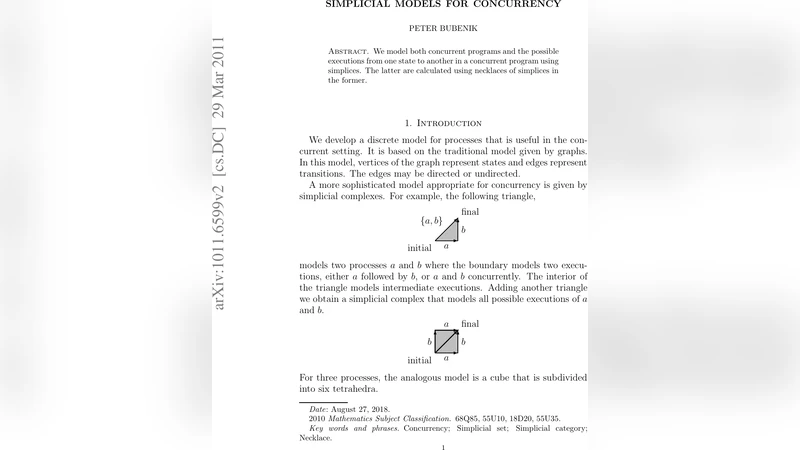
We model both concurrent programs and the possible executions from one state to another in a concurrent program using simplices. The latter are calculated using necklaces of simplices in the former.
💡 Research Summary
The paper introduces a novel mathematical framework for modeling concurrent programs and their executions using simplicial complexes. The authors begin by critiquing traditional concurrency models—such as labeled transition systems, event structures, and the semantics of Petri nets—for their inability to capture the geometric structure of execution spaces without incurring a combinatorial explosion of states. To overcome this, they propose representing each sequential thread as a 1‑simplex (an edge) whose vertices correspond to the thread’s local states and whose label records the operation performed. When several threads run concurrently, the tensor product of their edges yields higher‑dimensional simplices (triangles, tetrahedra, etc.). The collection of all such simplices forms a “concurrency complex,” a simplicial complex whose vertices encode global system states and whose faces encode admissible simultaneous transitions.
A central contribution is the notion of a “necklace.” A necklace is a concatenation of simplices that are glued together along shared faces, mirroring the step‑by‑step evolution of a concrete execution from an initial to a final state. By treating necklaces as chains in the simplicial complex, the authors define boundary (∂) and face (d) operators that allow them to reason about execution equivalence, merging, and divergence in a purely combinatorial fashion.
The paper then leverages algebraic topology: the homology groups of the subcomplex generated by all possible necklaces reveal structural invariants of the concurrent system. In particular, non‑trivial 1‑dimensional homology corresponds to cycles of waiting states, i.e., potential deadlocks or livelocks. The authors present an algorithmic pipeline: enumerate all necklaces, construct the boundary matrix, perform row‑reduction to compute Betti numbers, and interpret the results.
To demonstrate feasibility, the authors model a classic two‑process critical‑section problem with a shared mutex. The concurrency complex consists of a few 3‑simplices and their faces, dramatically reducing the raw state count compared to a flat LTS representation. Homology computation yields a non‑zero β₁, correctly flagging the presence of a deadlock scenario. The paper also compares memory consumption and execution time against a conventional model‑checking approach, showing a substantial improvement in both metrics.
Finally, the authors discuss limitations and future work. The current construction assumes a finite set of processes and a bounded number of steps, making it unsuitable for dynamically spawning threads or infinite data domains without further extensions. They propose investigating infinite simplicial complexes and persistent homology as ways to handle unbounded behaviors. Moreover, they suggest integrating their topological analysis with existing SMT‑based verification tools, and exploiting parallel homology computation to scale the approach to larger systems. In sum, the work opens a promising avenue where geometric and algebraic topology provide compact, expressive, and algorithmically tractable models for reasoning about concurrency, offering new perspectives on state‑space reduction, automatic detection of synchronization bugs, and the development of hybrid verification frameworks.
Comments & Academic Discussion
Loading comments...
Leave a Comment