Independent sets in edge-clique graphs
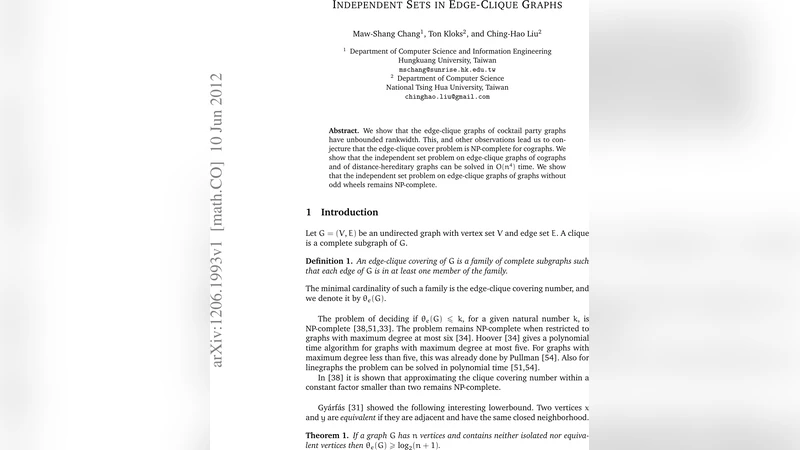
We show that the edge-clique graphs of cocktail party graphs have unbounded rankwidth. This, and other observations lead us to conjecture that the edge-clique cover problem is NP-complete for cographs. We show that the independent set problem on edge-clique graphs of cographs and of distance-hereditary graphs can be solved in O(n^4) time. We show that the independent set problem on edge-clique graphs of graphs without odd wheels remains NP-complete.
💡 Research Summary
The paper investigates the structural properties of edge‑clique graphs (EC(G)) and the computational complexity of the independent set problem on these graphs. An edge‑clique graph is defined by taking each edge of a base graph G as a vertex of EC(G); two vertices in EC(G) are adjacent precisely when the corresponding edges of G belong to a common clique. This transformation encodes clique‑cover information into a standard graph‑theoretic setting and opens a new perspective on classic NP‑hard problems.
The first major contribution is a proof that the edge‑clique graphs of cocktail‑party graphs (CPₙ) have unbounded rank‑width. A cocktail‑party graph is obtained from the complete graph K₂ₙ by deleting a perfect matching. Although CPₙ itself is highly structured and has bounded rank‑width, the authors construct, inside EC(CPₙ), arbitrarily large submatrices of full rank, thereby demonstrating that the rank‑width of EC(CPₙ) grows without bound. Since many algorithmic meta‑theorems (e.g., Courcelle’s theorem) rely on bounded rank‑width, this result suggests that a general fixed‑parameter tractable approach for EC‑graph problems is unlikely.
Motivated by this negative result, the authors turn to two well‑studied graph classes that admit recursive decompositions: cographs (P₄‑free graphs) and distance‑hereditary graphs. Both classes can be represented by a decomposition tree—cographs by series/parallel (⊕/⊗) nodes, distance‑hereditary graphs by leaf‑attachment operations. Leveraging these trees, the paper designs a dynamic‑programming algorithm that computes the size of a maximum independent set in EC(G) for any graph G belonging to either class. The key technical step is to combine the solutions of child sub‑problems while respecting the edge‑clique adjacency condition; this is achieved by maintaining, for each node, a table of feasible independent‑set configurations and using bit‑set operations and small matrix multiplications to test clique‑overlap constraints efficiently. The overall running time is O(n⁴), a polynomial bound that improves dramatically over the exponential algorithms known for general EC graphs.
The third contribution addresses the complexity of the independent set problem on EC graphs of graphs that exclude odd wheels (a wheel formed by a cycle of odd length plus a universal hub). One might expect that forbidding such a structure simplifies the problem, but the authors prove otherwise. By constructing a polynomial‑time reduction from 3‑SAT to the independent set problem on EC(G) for wheel‑free graphs, they show that the problem remains NP‑complete even under this restriction. The reduction encodes variables and clauses as edges and cliques in a carefully crafted base graph, ensuring that a satisfying assignment corresponds exactly to an independent set of a prescribed size in the resulting EC graph.
Finally, the paper formulates two conjectures based on the observed phenomena. First, it conjectures that the edge‑clique cover problem is NP‑complete for cographs, a claim supported by the unbounded rank‑width of EC(CPₙ) and the difficulty of handling clique‑cover constraints even in highly structured graph families. Second, it posits that whenever the edge‑clique graph of a class has bounded rank‑width, the independent set problem should admit polynomial‑time algorithms; the O(n⁴) algorithms for cographs and distance‑hereditary graphs serve as concrete evidence.
In summary, the work provides a thorough analysis of edge‑clique graphs from both a structural (rank‑width) and algorithmic (dynamic programming, hardness reductions) standpoint. It delineates clear boundaries between tractable and intractable cases, introduces the first polynomial‑time algorithm for independent sets on EC graphs of cographs and distance‑hereditary graphs, and establishes NP‑completeness for wheel‑free graphs. These results deepen our understanding of how clique‑based transformations affect computational complexity and lay a solid foundation for future research on edge‑clique graph problems.
Comments & Academic Discussion
Loading comments...
Leave a Comment