Patience of Matrix Games
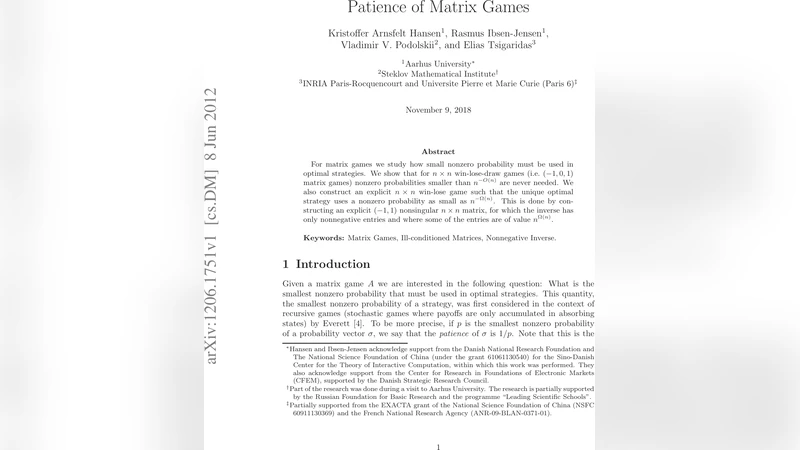
For matrix games we study how small nonzero probability must be used in optimal strategies. We show that for nxn win-lose-draw games (i.e. (-1,0,1) matrix games) nonzero probabilities smaller than n^{-O(n)} are never needed. We also construct an explicit nxn win-lose game such that the unique optimal strategy uses a nonzero probability as small as n^{-Omega(n)}. This is done by constructing an explicit (-1,1) nonsingular nxn matrix, for which the inverse has only nonnegative entries and where some of the entries are of value n^{Omega(n)}.
💡 Research Summary
The paper investigates how small a non‑zero probability must be in an optimal mixed strategy for matrix games, a quantity the authors term “patience” (the reciprocal of the smallest probability used). The focus is on n × n win‑lose‑draw games, i.e., zero‑sum games whose payoff matrix entries belong to {−1, 0, 1}.
First, the authors establish a universal upper bound on patience. By formulating the game as a linear program and examining its basic feasible solutions, they show that any optimal strategy can be expressed using at most n basic variables. The non‑basic probabilities are linear combinations of the basic ones, involving entries of the inverse of a sub‑matrix of the payoff matrix. Because the original matrix entries are bounded by 1 in absolute value, the determinant of any n × n sub‑matrix is at most n! and each cofactor is at most 1 in magnitude. Consequently each entry of the inverse is bounded by n! ≤ n^{n}, which implies that the smallest non‑zero probability in any optimal strategy is at least n^{−O(n)}. In other words, patience never exceeds an exponential function of n.
The second major contribution is a matching lower bound: the authors construct an explicit family of win‑lose (−1, 1) games for which the unique optimal strategy contains a probability as small as n^{−Ω(n)}. The construction hinges on a specially designed nonsingular matrix A with entries in {−1, 1} whose inverse is entry‑wise non‑negative and contains entries of magnitude n^{Ω(n)}. When A^{-1} is non‑negative, the optimal strategy for the row player can be written as the normalized row‑sums of A^{-1}. Hence a single large entry in A^{-1} forces a correspondingly tiny probability in the strategy.
To build such a matrix, the authors start from a recursive combinatorial pattern reminiscent of torus graphs. They define a Boolean function f(i, j) that determines the sign of each entry: A_{ij}= (−1)^{f(i,j)}. The recursion guarantees that A is nonsingular and that its inverse consists solely of non‑negative integers. By analyzing the growth of the determinant and the cofactors, they prove that some entries of A^{-1} grow like n^{c n} for a constant c > 0. This yields a game whose optimal mixed strategy has a minimum probability of order n^{−c n}, establishing the lower bound.
The paper therefore shows that the patience of n × n win‑lose‑draw games is tightly bounded between n^{−O(n)} and n^{−Ω(n)}; the two bounds match up to constant factors in the exponent. This result introduces a new quantitative measure of strategic complexity in matrix games and connects it to classical topics in linear algebra, such as inverse‑nonnegative matrices and the magnitude of matrix inverses.
Beyond the immediate bounds, the authors discuss several implications and open directions. The existence of matrices with non‑negative inverses and exponentially large entries links the study to M‑matrices and to the theory of totally non‑negative matrices. The concept of patience could be extended to random payoff matrices, to games with larger payoff alphabets, or to approximation algorithms that aim to reduce patience while preserving near‑optimality. Overall, the work provides a rigorous foundation for understanding how “fine‑grained” probabilities must be in optimal strategies and opens a line of inquiry at the intersection of game theory, combinatorial matrix theory, and computational complexity.
Comments & Academic Discussion
Loading comments...
Leave a Comment