Towards the Notion of an Abstract Quantum Automaton
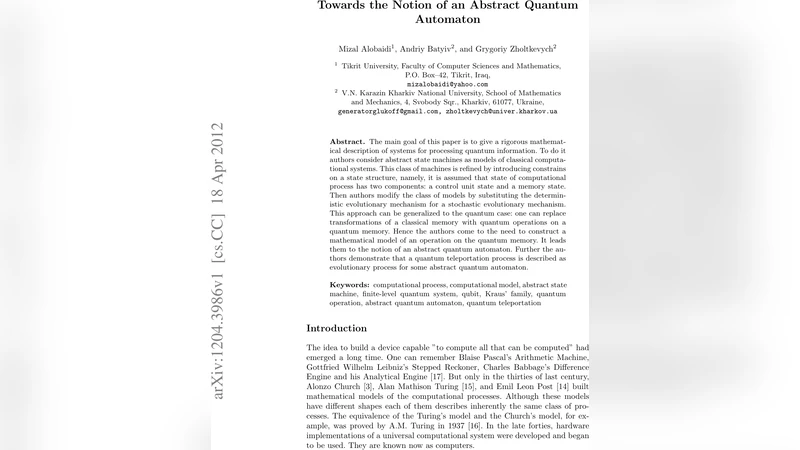
The main goal of this paper is to give a rigorous mathematical description of systems for processing quantum information. To do it authors consider abstract state machines as models of classical computational systems. This class of machines is refined by introducing constrains on a state structure, namely, it is assumed that state of computational process has two components: a control unit state and a memory state. Then authors modify the class of models by substituting the deterministic evolutionary mechanism for a stochastic evolutionary mechanism. This approach can be generalized to the quantum case: one can replace transformations of a classical memory with quantum operations on a quantum memory. Hence the authors come to the need to construct a mathematical model of an operation on the quantum memory. It leads them to the notion of an abstract quantum automaton. Further the authors demonstrate that a quantum teleportation process is described as evolutionary process for some abstract quantum automaton.
💡 Research Summary
The paper sets out to provide a rigorous mathematical framework for systems that process quantum information by extending the well‑established theory of abstract state machines (ASMs). Classical ASMs model computation as a deterministic transition function over a single set of states. The authors first point out that this model is insufficient for quantum computation because quantum states live in a Hilbert space, evolve via linear (often non‑unitary) maps, and involve intrinsic probabilistic measurement outcomes. To bridge this gap they introduce two structural refinements.
First, the global state of a computation is split into a control unit state (c) and a memory state (\rho). The control unit is a finite, classical component that governs the flow of the algorithm (similar to the program counter in a Turing machine). The memory state is a density operator on a Hilbert space (\mathcal{H}) and represents the quantum data that the algorithm manipulates. This separation mirrors the classical distinction between a finite‑state controller and an infinite tape, but it allows the tape to be a genuine quantum system.
Second, the deterministic transition function is replaced by a stochastic‑quantum transition operator (\delta). For a given pair ((c,\rho)) the operator produces a probability distribution over new pairs ((c_i,\mathcal{E}_i(\rho))): \
Comments & Academic Discussion
Loading comments...
Leave a Comment