Dynamical orbital effects of General Relativity on the satellite-to-satellite range and range-rate in the GRACE mission: a sensitivity analysis
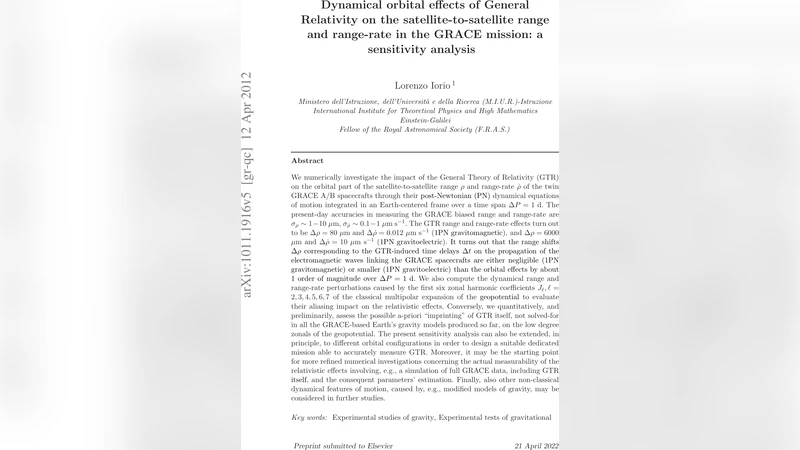
We numerically investigate the impact of GTR on the orbital part of the satellite-to-satellite range \rho and range-rate \dot\rho of the twin GRACE A/B spacecrafts through their dynamical equations of motion integrated in an Earth-centered frame over a time span \Delta t=1 d. Instead, the GTR effects connected with the propagation of the electromagnetic waves linking the spacecrafts are neglected. The present-day accuracies in measuring the GRACE biased range and range-rate are \sigma_\rho\sim 1-10 \mum, \sigma_\dot\rho\sim 0.1-1 \mum s^-1; studies for a follow-on of such a mission points toward a range-rate accuracy of the order of \sigma_\dot\rho\sim 1 nm s^-1 or better. The GTR range and range-rate effects turn out to be \Delta\rho=80 \mum and \Delta\dot\rho=0.012 \mum s^-1 (Lense-Thirring), and \Delta\rho=6000 \mum and \Delta\dot\rho=10 \mum s^-1 (Schwarzschild). We also compute the dynamical range and range-rate perturbations caused by the first six zonal harmonic coefficients J_L, L=2,3,4,5,6,7 of the classical multipolar expansion of the terrestrial gravitational potential in order to evaluate their aliasing impact on the relativistic effects. Conversely, we also quantitatively, and preliminarily, assess the possible a-priori \virg{imprinting} of GTR itself, not solved-for in all the GRACE-based Earth’s gravity models produced so far, on the estimated values of the low degree zonals of the geopotential. The present sensitivity analysis can also be extended, in principle, to different orbital configurations in order to design a suitable dedicated mission able to accurately measure the relativistic effects considered.
💡 Research Summary
The paper investigates how the two primary post‑Newtonian effects of General Relativity— the Schwarzschild (static spacetime curvature) and the Lense‑Thirring (frame‑dragging due to Earth’s rotation) terms— influence the inter‑satellite range (ρ) and range‑rate (ρ̇) measured by the GRACE A/B twin‑satellite mission. The authors construct a dynamical model that augments the Newtonian Earth‑gravity acceleration with the first‑order relativistic corrections and integrate the equations of motion in an Earth‑centered inertial frame over a 24‑hour interval. Electromagnetic‑wave propagation effects (Shapiro delay, etc.) are deliberately omitted, so the analysis isolates purely orbital relativistic perturbations.
Current GRACE measurement capabilities are quoted as σ_ρ≈1–10 µm for the biased range and σ_ρ̇≈0.1–1 µm s⁻¹ for the range‑rate, while a prospective follow‑on mission aims at σ_ρ̇≈1 nm s⁻¹. Within this context the numerical results show that the Lense‑Thirring contribution amounts to Δρ≈80 µm and Δρ̇≈0.012 µm s⁻¹, whereas the Schwarzschild term yields a much larger Δρ≈6 mm (6000 µm) and Δρ̇≈10 µm s⁻¹. The Schwarzschild signal is therefore well above present‑day noise, suggesting that, with appropriate data reduction, a direct detection is feasible. The Lense‑Thirring signal, though smaller, could become observable in a mission with the envisaged nanometre‑per‑second range‑rate accuracy.
To assess the risk of aliasing, the authors also compute the dynamical perturbations induced by the first six even zonal harmonics of the Earth’s geopotential (J₂–J₇). These classical gravity coefficients generate range and range‑rate signatures comparable to, and in some cases larger than, the relativistic effects. In particular, the J₂‑induced range perturbation reaches several centimetres, dwarfing the Lense‑Thirring signal and rivaling the Schwarzschild term. Consequently, any attempt to isolate relativistic signatures must either employ a geopotential model with sufficiently accurate low‑degree zonals or perform a simultaneous estimation of the relativistic parameters together with the zonal coefficients.
A further, more subtle issue examined is the possible “imprinting” of General Relativity onto the geopotential coefficients themselves. Since all existing GRACE‑derived Earth‑gravity solutions have been obtained without explicitly solving for relativistic terms, the unmodelled relativistic accelerations may have been absorbed into the estimated J₂–J₇ values. By generating synthetic data that include the relativistic accelerations and then re‑estimating the zonal coefficients under a purely Newtonian model, the authors quantify the resulting biases. The study finds percent‑level shifts in the low‑degree zonals, which could represent a non‑negligible systematic error in high‑precision gravity fields.
Finally, the paper argues that the presented sensitivity analysis is not limited to the current GRACE configuration. By varying orbital altitude, inclination, and inter‑satellite separation, one can design a dedicated mission optimized for relativistic measurements. Higher orbits and larger separations increase the relativistic signal while reducing the relative impact of low‑degree geopotential errors; improved laser interferometry would further lower the range‑rate noise floor. Such a mission could, in principle, provide simultaneous high‑precision determinations of both the Schwarzschild and Lense‑Thirring effects, thereby offering an independent test of General Relativity in the Earth’s weak‑field regime and improving the fidelity of future geopotential models.
In summary, the work demonstrates that the GRACE twin‑satellite system possesses sufficient sensitivity to detect the static Schwarzschild perturbation and, with next‑generation instrumentation, the much smaller frame‑dragging effect. It also highlights the necessity of careful modelling of low‑degree geopotential harmonics and the potential for relativistic “imprinting” on existing gravity solutions, thereby laying the groundwork for future dedicated relativistic gravity missions.
Comments & Academic Discussion
Loading comments...
Leave a Comment