Bounded distortion homeomorphisms on ultrametric spaces
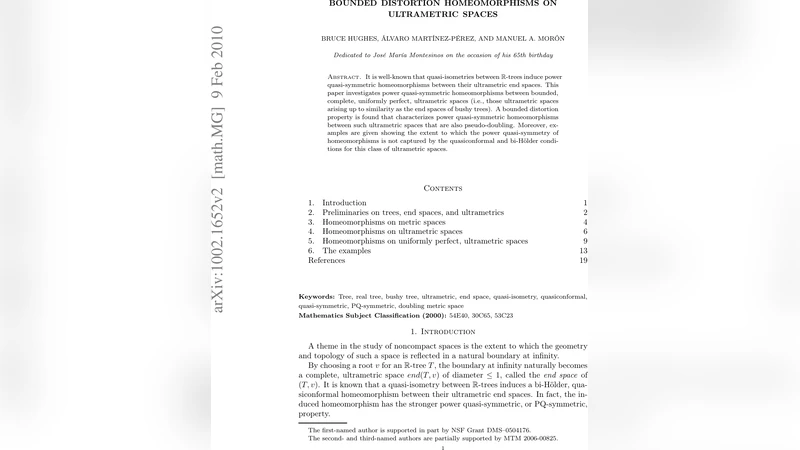
It is well-known that quasi-isometries between R-trees induce power quasi-symmetric homeomorphisms between their ultrametric end spaces. This paper investigates power quasi-symmetric homeomorphisms between bounded, complete, uniformly perfect, ultrametric spaces (i.e., those ultrametric spaces arising up to similarity as the end spaces of bushy trees). A bounded distortion property is found that characterizes power quasi-symmetric homeomorphisms between such ultrametric spaces that are also pseudo-doubling. Moreover, examples are given showing the extent to which the power quasi-symmetry of homeomorphisms is not captured by the quasiconformal and bi-H"older conditions for this class of ultrametric spaces.
💡 Research Summary
The paper investigates homeomorphisms between a distinguished class of ultrametric spaces—those that are bounded, complete, uniformly perfect, and pseudo‑doubling, which precisely correspond (up to similarity) to the end spaces of bushy (\mathbb{R})-trees. The motivation stems from the well‑known fact that a quasi‑isometry between two (\mathbb{R})-trees induces a power‑quasi‑symmetric (PQS) homeomorphism between their ultrametric end spaces. The authors ask whether, within the more abstract ultrametric setting, the PQS property can be characterized by a purely metric distortion condition that does not refer to an underlying tree.
To answer this, they introduce the bounded distortion property (BDP). For a homeomorphism (f : X \to Y) between ultrametric spaces, BDP requires the existence of a constant (C\ge 1) such that for every point (x\in X) and every radius (r>0), \
Comments & Academic Discussion
Loading comments...
Leave a Comment