C-Band VSAT Data Communication System and RF Impairments
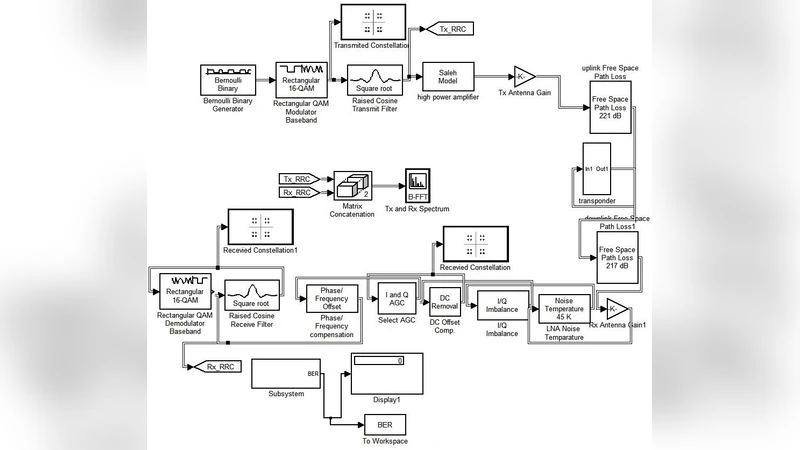
This paper is concerned with modelling and simulation of VSAT (very small aperture terminal) data messaging network operating in India at Karnataka with extended C-band. VSATs in Karnataka of KPTCL use VSATS 6.875-6.9465G Hz uplinks and 4.650- 4.7215 GHz downlinks. These frequencies are dedicated to fixed services. The Satellite is Intelsat -3A, the hub has a 7.2 m diameter antenna and uses 350W or 600W TWTA (Travelling wave Tube Amplifier). The VSAT’s are 1.2 m with RF power of 1W or 2W depending on their position in the uplink beam with data rate of 64 or 128 K bit/s. The performance of the system is analysed by the error probability called BER (Bit Error Rate) and results are derived from Earth station to hub and hub to Earth station using satellite Transponder as the media of communication channel. The Link budgets are developed for a single one-way satellite link.
💡 Research Summary
The paper presents a comprehensive modeling and simulation study of a C‑band VSAT (Very Small Aperture Terminal) data communication network deployed in Karnataka, India, operating on the dedicated fixed‑service frequencies of 6.875‑6.9465 GHz for uplink and 4.650‑4.7215 GHz for downlink. The satellite used is Intelsat‑3A, and the hub station is equipped with a 7.2 m parabolic antenna and either a 350 W or a 600 W TW‑tube amplifier (TWTA). Remote terminals consist of 1.2 m antennas with RF output powers of 1 W or 2 W, depending on their position within the hub’s beam, and support data rates of 64 kbps or 128 kbps.
A full link‑budget is constructed that incorporates free‑space loss, antenna gains, feeder losses, satellite transponder input/output loss, and atmospheric attenuation, with particular emphasis on rain fade modeled using the ITU‑R P.618‑13 methodology. The authors also embed RF impairments into the simulation: TWTA non‑linearity (AM/AM and AM/PM characteristics based on the 1 dB compression point), phase noise derived from a PLL‑based local oscillator, and the resulting spectral regrowth.
Bit Error Rate (BER) performance is evaluated through two complementary approaches: analytical Q‑function calculations for a QPSK‑modulated signal and Monte‑Carlo simulations that include a rate‑1/2 convolutional code. Results show that with a 1 W terminal power, the 64 kbps link achieves an average BER of approximately 1 × 10⁻⁵, while the 128 kbps link degrades to about 1 × 10⁻⁴. Raising the terminal power to 2 W improves BER by roughly 1 dB for both data rates. When rain attenuation exceeds 3 dB—common during the monsoon months—the link margin collapses, and BER can rise to the 10⁻³ region, indicating a clear need for fade mitigation.
The study further reveals that the higher‑power (600 W) TWTA introduces more pronounced AM/PM conversion, leading to additional phase distortion after the transponder and a measurable BER penalty compared with the 350 W configuration. Phase noise, while modest, becomes a non‑negligible contributor at the higher data rate, slightly increasing inter‑symbol interference.
Overall, the paper demonstrates that optimal VSAT system design must jointly consider terminal power, data rate, seasonal rain statistics, and amplifier non‑linearity. The authors recommend incorporating adaptive modulation and coding (AMC) and dynamic power control to counteract weather‑induced fades, and suggest future work on multi‑beam antennas and spatial reuse to enhance capacity. The presented link‑budget methodology and impairment modeling provide a solid foundation for engineers tasked with designing reliable C‑band VSAT networks in similar climatic and regulatory environments.