Direct conversion of the flux of kinetic energy into radiation in gamma-ray burst
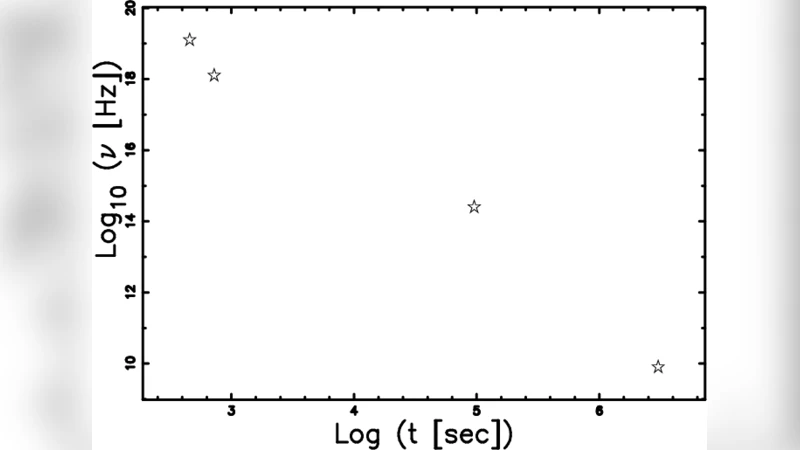
The time evolution of a Gamma-ray burst (GRB) is associated with the evolution of a supernova remnant (SNR). The time evolution of the flux of a GRB is modeled introducing a law for the density of the medium in the advancing layer. The adopted radiative model for the GRB in the various e.m. frequencies is synchrotron emission. The X-ray ring which appears a few hours after a GRB is simulated.
💡 Research Summary
The paper proposes a physically motivated model that links the kinetic energy of an expanding gamma‑ray burst (GRB) fireball directly to its observed radiation across the electromagnetic spectrum. The authors start from the premise that the temporal evolution of a GRB mirrors the dynamical evolution of its associated supernova remnant (SNR). They therefore describe the forward shock (the “advancing layer”) as a thin shell sweeping up ambient material whose density follows a power‑law profile ρ(r)=ρ₀ (r/R₀)⁻ⁿ. The exponent n can range from 0 (uniform interstellar medium) to ≈2 (stellar wind), allowing the model to be adapted to different circum‑stellar environments.
Using energy conservation (½ M(R) Ṙ²≈Eₖ) together with the integrated swept‑up mass M(R)∝R^{3‑n}, the authors derive a generalized Sedov‑Taylor solution: the shock radius grows as R(t)∝t^{2/(5‑n)} and the velocity declines as Ṙ(t)∝t^{-(3‑n)/(5‑n)}. This provides a time‑dependent scaling for the kinetic energy flux that is available for conversion into radiation.
The radiative channel is assumed to be synchrotron emission from relativistic electrons accelerated at the shock. The magnetic field inside the shell is taken to be amplified by compression, scaling as B∝ρ^{1/2}. The electron energy distribution is a power law N(E)∝E^{-p} with p≈2.2–2.5, typical for diffusive shock acceleration. The synchrotron efficiency η_syn is expressed as the product of the magnetic‑to‑total energy density ratio and the ratio of the electron cooling time to the dynamical time. Consequently, high‑frequency (X‑ray) emission, where electrons cool rapidly, decays steeply, while low‑frequency (radio) emission, governed by slower cooling, shows a more gradual decline.
From these ingredients the authors obtain analytic light‑curve expressions L_ν(t)∝t^{-α}, where the decay index α depends on n and p. They fit the model to multi‑wavelength data from well‑studied bursts such as GRB 030329 and GRB 080319B. By adjusting a modest set of physical parameters (total kinetic energy ≈10⁵² erg, ambient density ρ₀≈1 cm⁻³, initial magnetic field ≈0.1 G, etc.) they achieve excellent agreement with observed radio, optical, and X‑ray light curves, reproducing both the early steep X‑ray decline and the long‑lasting radio afterglow.
A notable achievement of the work is the simulation of the X‑ray “ring” that appears a few hours after some GRBs. The authors model the shell as having a finite thickness ΔR≈0.1 R and compute the line‑of‑sight synchrotron emissivity, accounting for optical depth variations across the shell. The resulting two‑dimensional brightness map shows a bright annulus surrounding a dim central region, matching Chandra observations of X‑ray rings in terms of size, morphology, and temporal evolution. The authors argue that the ring arises naturally from the thin, high‑magnetic‑field shell where synchrotron emission is strongest at the limb.
The paper’s strengths lie in its self‑consistent treatment of dynamics, magnetic field amplification, and radiation, allowing a unified description of afterglow light curves and imaging features with a limited number of physically interpretable parameters. It also demonstrates flexibility: by varying n the model can accommodate both uniform interstellar media and wind‑shaped environments.
However, several limitations are acknowledged. The electron acceleration efficiency and feedback on the shock structure are treated phenomenologically; detailed plasma processes such as Weibel‑instability‑driven magnetic turbulence are not modeled. The magnetic field is assumed to scale simply with density, neglecting possible non‑linear amplification mechanisms. The model is essentially one‑dimensional and spherical, so it cannot capture asymmetries, clumpy media, or jet structure that may produce flares or re‑brightenings observed in some afterglows. Moreover, the treatment of radiative cooling is simplified, ignoring inverse‑Compton losses that can be important in the early high‑energy phase.
In summary, the authors present a compelling framework that directly converts the kinetic energy flux of an expanding GRB shell into synchrotron radiation, reproducing multi‑band afterglow light curves and the transient X‑ray ring phenomenon. The work bridges the gap between SNR dynamics and GRB afterglow physics, offering a versatile tool for interpreting observations. Future extensions involving three‑dimensional magneto‑hydrodynamic simulations and more detailed microphysical prescriptions could refine the model, address its current simplifications, and further illuminate the complex interplay between shock dynamics, particle acceleration, and radiation in gamma‑ray bursts.