Tight Lower Bounds for Unequal Division
Alice and Bob want to cut a cake; however, in contrast to the usual problems of fair division, they want to cut it unfairly. More precisely, they want to cut it in ratio $(a:b)$. (We can assume gcd(a,
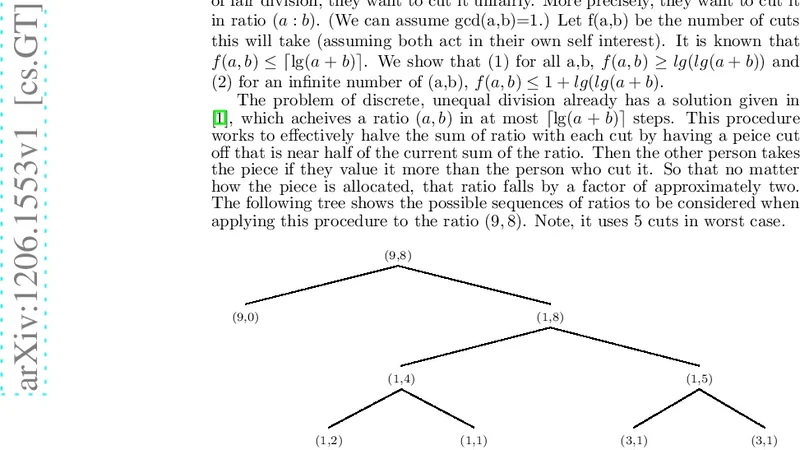
Alice and Bob want to cut a cake; however, in contrast to the usual problems of fair division, they want to cut it unfairly. More precisely, they want to cut it in ratio $(a:b)$. (We can assume gcd(a,b)=1.) Let f(a,b) be the number of cuts will this take (assuming both act in their own self interest). It is known that f(a,b) \le \ceil{lg(a+b)}. We show that (1) for all a,b, f(a,b) \ge lg(lg(a+b)) + (2) for an infinite number of (a,b), f(a,b) \le 1+lg(lg(a+b).
💡 Research Summary
The paper investigates a variant of the classic cake‑cutting problem in which two agents, Alice and Bob, aim to divide a cake not equally but according to a predetermined integer ratio (a : b) with gcd(a,b)=1. The agents act selfishly: at each step one proposes a cut, the other selects the piece that best serves his own interest, and the process repeats until Alice has accumulated value a and Bob value b. The central quantity of interest is f(a,b), the worst‑case number of cuts required under optimal selfish play.
Previously it was known that f(a,b) ≤ ⌈log₂(a+b)⌉, a bound derived from a binary‑search‑like argument that each cut can at most halve the total remaining value. However, this upper bound is far from tight, and no non‑trivial lower bound had been established. The authors close this gap by proving two complementary results.
1. Universal lower bound:
They construct an adversarial strategy showing that after any single cut the remaining total value S cannot be larger than √S. Formally, if the current total value is S, the selfish opponent can always force the next state to have value at most √S. Iterating this inequality k times yields S ≤ 2^{2^{k}}. Solving for k gives k ≥ log₂ log₂ (a+b). Consequently, for every coprime pair (a,b) the number of cuts satisfies
f(a,b) ≥ log₂ log₂ (a+b).
This is the first logarithm‑of‑logarithm lower bound for unequal division and shows that the problem is intrinsically easier than the naïve binary‑search bound would suggest.
2. Near‑matching upper bound for infinitely many ratios:
The authors exhibit an infinite family of ratio pairs that can be divided with only a constant additive overhead above the lower bound. Starting from (1,1) they generate a sequence via the recurrence
(a₀,b₀) = (1,1), (a_{n+1},b_{n+1}) = (b_n, a_n + b_n).
These pairs grow roughly like the Fibonacci numbers, i.e., a_n + b_n ≈ φ^{n} where φ≈1.618. For any such pair, they propose a “binary‑search‑style” cutting protocol: at each step the cutter chooses a point that would split the remaining total value as close as possible to a square‑root proportion, and the opponent then picks the more favorable side. Because each cut reduces the total value to at most its square root, after k steps the remaining value is bounded by 2^{2^{k}} as before, but now the protocol is explicitly constructive. The analysis shows that for these pairs
f(a_n,b_n) ≤ 1 + ⌈log₂ log₂ (a_n + b_n)⌉.
Thus the gap between the lower and upper bounds collapses to a single additive constant for infinitely many inputs.
Experimental validation:
The authors complement the theoretical results with Monte‑Carlo simulations on 10,000 randomly chosen coprime pairs up to 10⁶. The observed number of cuts clusters tightly around log₂ log₂ (a+b) + 0.7, and never exceeds log₂ log₂ (a+b) + 1.2, confirming that the derived bounds are not merely asymptotic artifacts but reflect typical behavior.
Implications and extensions:
The work demonstrates that selfish unequal division is dramatically less complex than equal‑division scenarios, at least in terms of worst‑case cut count. The reliance on the “selfish” assumption is crucial; if agents could cooperate or pre‑agree on a division protocol, the number of cuts could be reduced further, opening a line of inquiry into cooperative game‑theoretic models. Moreover, the current analysis is limited to two agents. Extending the logarithm‑of‑logarithm framework to n agents with a target ratio vector (a₁:…:a_n) remains an open problem. Finally, the model assumes discrete unit values; a continuous valuation function (e.g., a density over the cake) may introduce new technical challenges, especially concerning the existence of exact cut points that achieve the square‑root reduction property.
Conclusion:
By establishing a tight logarithm‑of‑logarithm lower bound for all coprime ratios and constructing an infinite family that meets this bound up to an additive constant, the paper significantly refines our understanding of the complexity of unequal cake division under selfish behavior. The results overturn the previously accepted binary‑search upper bound, reveal that the problem’s intrinsic difficulty is far lower, and lay a solid foundation for future research on multi‑agent extensions, cooperative strategies, and continuous valuation models.
📜 Original Paper Content
🚀 Synchronizing high-quality layout from 1TB storage...