Combinatorial study of colored Hurwitz polyz^etas
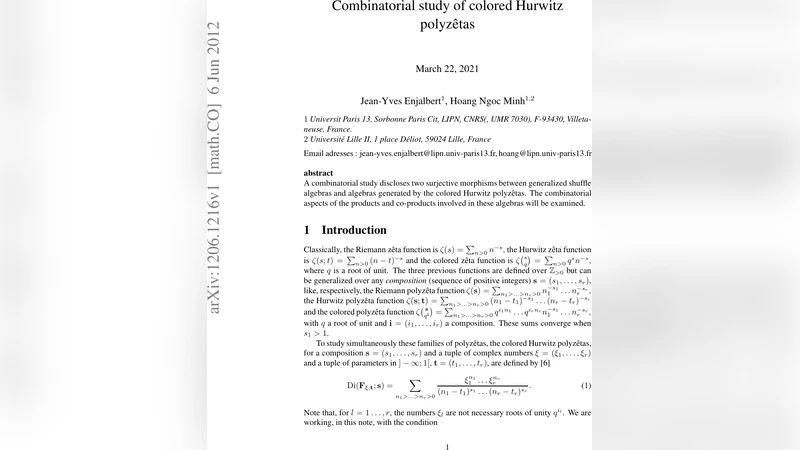
A combinatorial study discloses two surjective morphisms between generalized shuffle algebras and algebras generated by the colored Hurwitz polyz^etas. The combinatorial aspects of the products and co-products involved in these algebras will be examined.
💡 Research Summary
The paper investigates a novel class of objects called colored Hurwitz polyzetas (CHP), which extend the classical Hurwitz zeta function to a multi‑index setting and attach a “color” parameter to each index. The colors are drawn from an arbitrary set 𝒞 (which may consist of integers, rationals, or complex numbers) and serve as additional weights that modify the summation terms. By introducing a colored alphabet A = {a_{k,c} | k∈ℕ_{>0}, c∈𝒞}, the authors construct a free non‑commutative monoid M(A) equipped with two fundamental operations: a generalized shuffle product ⧢ and a deconcatenation coproduct Δ. This structure is a colored version of the quasi‑shuffle algebra, where the color of each letter is preserved during interleaving.
The central algebraic object of interest, denoted ℋ(𝒞), is the commutative algebra generated by all CHP of the form
\
Comments & Academic Discussion
Loading comments...
Leave a Comment